
The Lake Nasser temples are the monuments of Lower Nubia that were saved when the Aswan High Dam created one of the largest reservoirs in the world. Built over roughly 1,500 years by pharaohs, Ptolemaic kings and Roman emperors, they now stand on higher ground along the shores of Lake Nasser. This guide covers 12 monuments, who built each one, which gods they honour, and how to see them all on a dedicated Lake Nasser cruise with Oceanus Tours & Travel.
Why the Lake Nasser Temples Were Moved
The Aswan High Dam was built between 1960 and 1970. Its reservoir would have flooded the Nile banks of Lower Nubia, including dozens of ancient sites. In 1960, UNESCO launched an international campaign to save them, and many countries contributed funds and engineers.
Most temples were cut into blocks, moved to higher ground and reassembled. Amada was moved in one piece on rails. Abu Simbel was raised about 65 metres above its original position. Egypt also gave four temples to countries that helped: Dendur (United States), Taffeh (Netherlands), Debod (Spain) and Ellesyia (Italy). To learn more about the dam itself, read our guide to the Aswan High Dam.
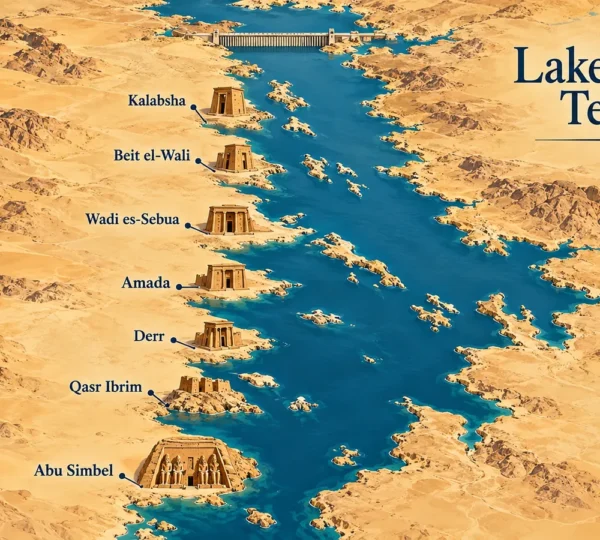
Illustrated map of the main Lake Nasser temples, from Kalabsha near the High Dam to Abu Simbel in the south.
Abu Simbel: The Great Temple and the Temple of Nefertari
Abu Simbel is the best-known of the Lake Nasser temples. Ramesses II carved two rock temples here in the 13th century BC. The Great Temple honours the king alongside Amun-Re, Ra-Horakhty and Ptah, and four seated statues of Ramesses, about 20 metres high, guard its facade.
The smaller temple is dedicated to Queen Nefertari and the goddess Hathor. It is unusual because the queen is shown at nearly the same scale as the king.
Twice a year, sunlight travels deep into the Great Temple and lights the sanctuary statues, with Ptah traditionally left in shadow. The dates are usually given as 22 February and 22 October. Between 1964 and 1968 the whole complex was cut into blocks and rebuilt on higher ground. Because the light depends on weather and crowds, the effect is never guaranteed on a given day.
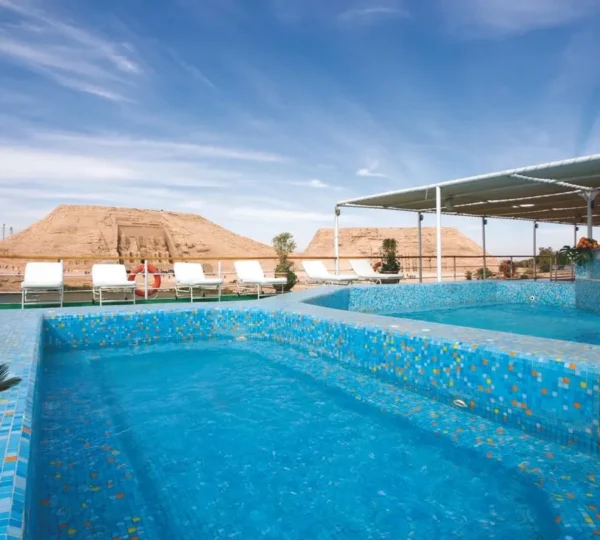
Relax on the sundeck of a Lake Nasser cruise with the Abu Simbel temples in view.
Kalabsha: The Largest Free-Standing Temple in Lower Nubia
The Temple of Kalabsha was built in the Roman period under Augustus and dedicated to Mandulis, a Nubian sun god. It is the largest free-standing temple in Lower Nubia, with a pylon, open court, hypostyle hall and sanctuary on a clear axis. A West German team moved it in the early 1960s, and it now stands at New Kalabsha near the High Dam.
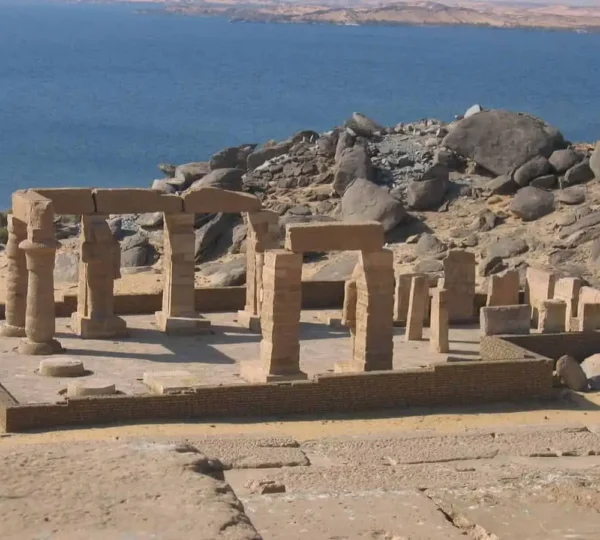
The Roman-period Kiosk of Qertassi stands at New Kalabsha above the waters of Lake Nasser.
Beit el-Wali and the Kiosk of Qertassi
Beit el-Wali is a small rock-cut temple built by Ramesses II. Its well-preserved reliefs show his campaigns in Nubia and the Near East. It was moved to New Kalabsha, where you can also see the Kiosk of Qertassi, a small Roman-period shrine with Hathor-headed columns. All three monuments at New Kalabsha have separate histories, even though they share one site today.
Wadi es-Sebua: The Valley of the Lions
Wadi es-Sebua means “Valley of the Lions” and is named for the avenue of sphinxes that leads to the temple. Ramesses II dedicated it to Amun-Re and Ra-Horakhty. In later centuries Christians used the building as a church and covered some reliefs with plaster, which helped to preserve traces of the original scenes. The temple was moved a short distance to New Wadi es-Sebua.
Dakka and Maharraqa
The Temple of Dakka is dedicated to Thoth, god of wisdom and writing. It was begun under the Ptolemaic king Ptolemy IV together with the Meroitic king Arqamani, and later rulers added to it. Its tall pylon is one of the best-preserved features.
The Temple of Maharraqa is a small Roman-period temple linked to Serapis and Isis. It was never finished, and its spiral staircase is a rare detail in Nubian architecture. Both temples now stand at New Wadi es-Sebua.
Amada, Derr and the Tomb of Pennut
The Temple of Amada is the oldest surviving monument on Lake Nasser. Thutmose III and Amenhotep II built it, and Thutmose IV added the hypostyle hall. It honours Amun-Re and Ra-Horakhty, and its reliefs keep much of their original colour. A stela of Amenhotep II describes his military campaign. In the 1960s and 1970s the temple was moved about 2.6 kilometres, intact and on rails, to its present site. Read more in the Ministry of Tourism and Antiquities entry on Amada.
Derr was built by Ramesses II for Ra-Horakhty and is one of the few rock-cut temples on the east bank in Nubia. It now stands at New Amada, along with the Tomb of Pennut. Pennut was Deputy of Wawat under Ramesses VI, so his tomb shows how Egypt governed Nubia.
Qasr Ibrim: The Site That Stayed in Place
Qasr Ibrim is a fortified settlement that was lived in for around 3,000 years. When the lake rose, its hilltop became an island instead of being submerged, so it was never moved. Larger cruise vessels cannot always approach the island closely, so access depends on the vessel and itinerary. Our team can confirm this before you book.
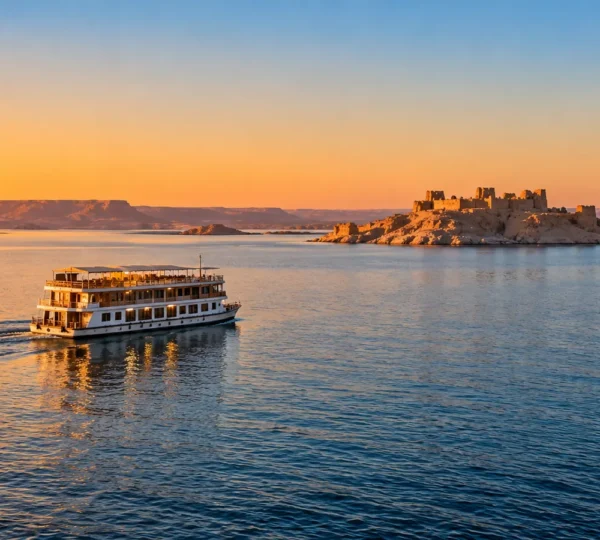
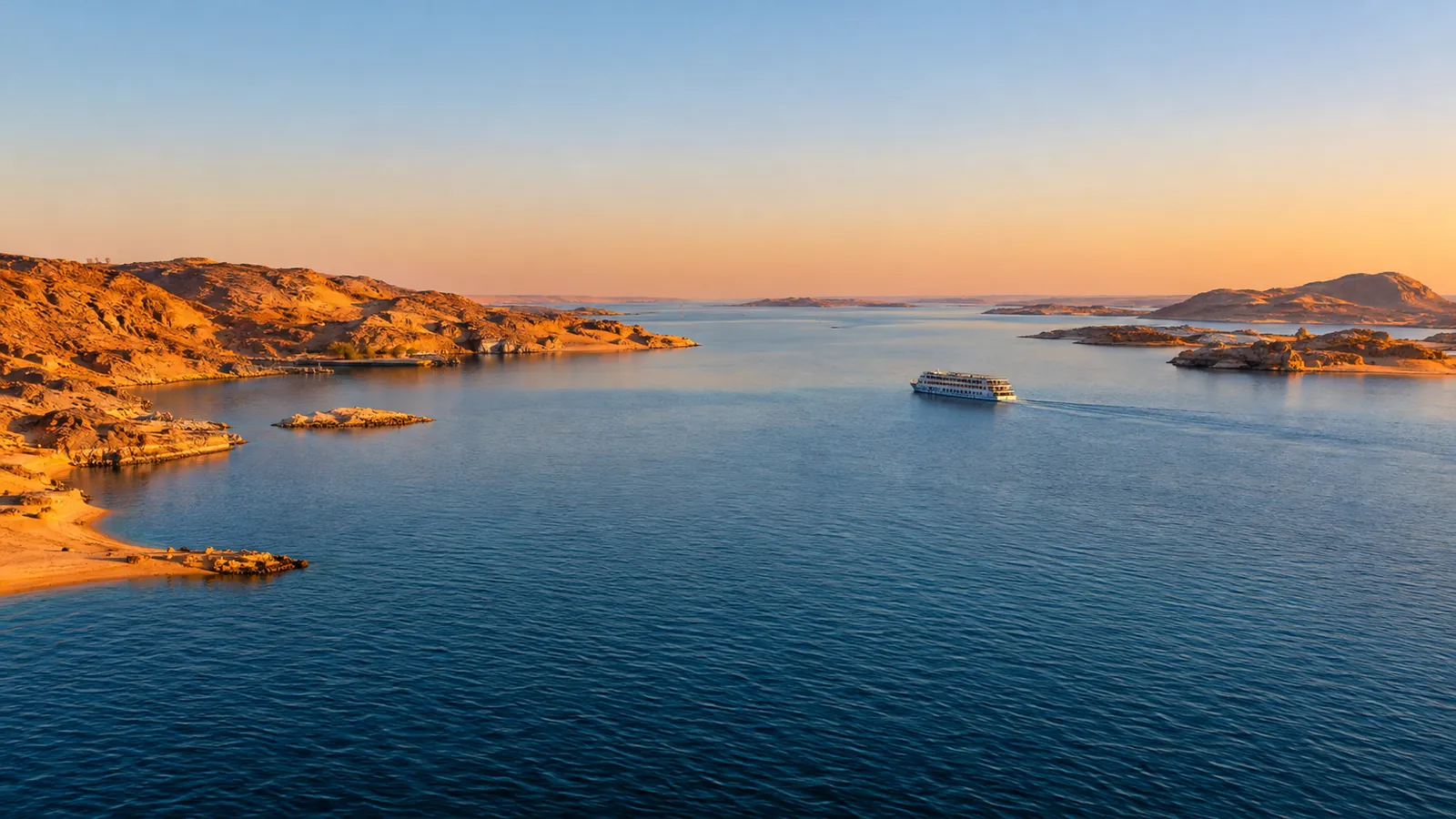
A Lake Nasser cruise glides past Qasr Ibrim as the sun sets over the water
Quick Comparison of the Main Lake Nasser Temples
| Temple | Builder | Period | Main deity |
|---|---|---|---|
| Abu Simbel | Ramesses II | New Kingdom | Ra-Horakhty, Amun-Re, Ptah; Hathor |
| Kalabsha | Augustus | Roman | Mandulis |
| Beit el-Wali | Ramesses II | New Kingdom | Amun-Re |
| Wadi es-Sebua | Ramesses II | New Kingdom | Amun-Re, Ra-Horakhty |
| Dakka | Ptolemy IV and Arqamani | Ptolemaic | Thoth |
| Amada | Thutmose III, Amenhotep II | New Kingdom | Amun-Re, Ra-Horakhty |
| Derr | Ramesses II | New Kingdom | Ra-Horakhty |
How to Visit the Lake Nasser Temples with Oceanus Tours & Travel
The Lake Nasser temples are spread along the lakeshore, and most of them are reached by water. A dedicated Lake Nasser cruise links them in one journey, so you unpack once and visit Kalabsha, Beit el-Wali, Wadi es-Sebua, Amada, Derr and Abu Simbel without long transfers.
Oceanus Tours & Travel can organise the full Lake Nasser trip as a private, tailor-made programme. We operate our own cruise, which departs from behind the High Dam, so you can visit the temples with a company guide at a pace that suits your group. These trips are arranged on request, not on a fixed public schedule, so the route, number of nights and sites can be adjusted. Contact us or call (+20) 101 806 4111 to plan your dates.
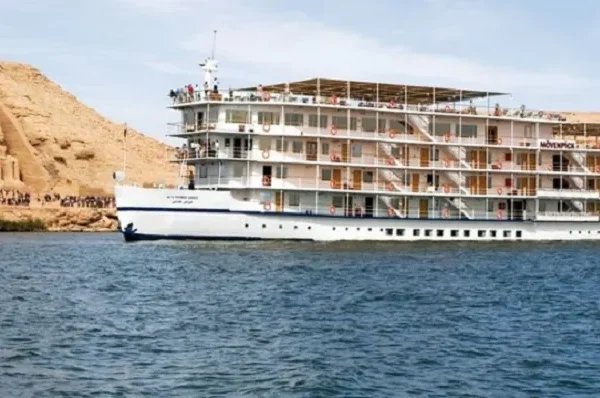
A Lake Nasser cruise ship passes the Great Temple of Abu Simbel.
Before you sail, many guests spend time in Aswan. Start with our Aswan travel guide, then see the Unfinished Obelisk and Philae Temple. You can also browse our Aswan day tours and Nile cruises, or ask us to build one program that joins the Nile and Lake Nasser.
Ask which entrance tickets, transfers, meals and guiding are included in your quote. Do not swim in the southern part of the lake, where Nile crocodiles live.
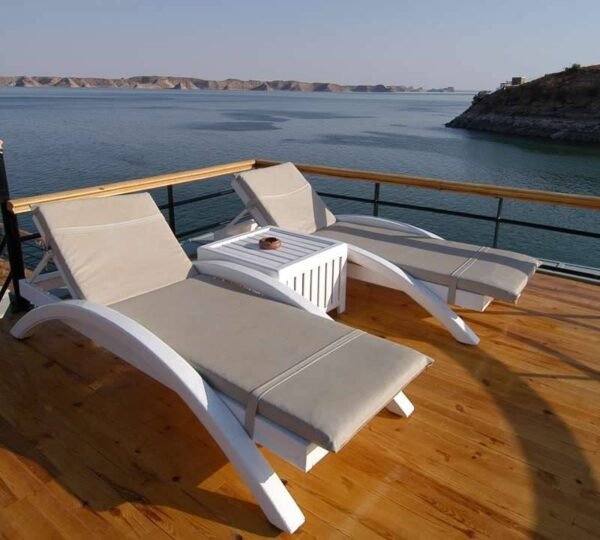
Sun loungers on the sundeck give a quiet view over Lake Nasser between temple visits.
Lake Nasser Temples FAQ
Which temples are on Lake Nasser?
The main ones are Abu Simbel, Kalabsha, Beit el-Wali, the Kiosk of Qertassi, Wadi es-Sebua, Dakka, Maharraqa, Amada, Derr and the Tomb of Pennut. Qasr Ibrim is also part of the group.
Why were the Lake Nasser temples moved?
The reservoir behind the Aswan High Dam would have flooded them. An international UNESCO campaign funded and organised their relocation.
Is Philae one of the Lake Nasser temples?
No. Philae was also moved, but it now stands on Agilkia Island in Aswan, not on Lake Nasser. Read our Philae Temple guide.
What is the oldest temple on Lake Nasser?
The Temple of Amada, begun under Thutmose III, is the oldest surviving monument on the lake.
Can I see the Lake Nasser temples without a cruise?
Abu Simbel can be visited on its own as a day trip from Aswan, but the other temples are scattered along the shore and are most practical by cruise. A dedicated Lake Nasser cruise, such as the private programme Oceanus Tours & Travel arranges, visits them in one trip.
Can I swim in Lake Nasser?
It is not recommended. Nile crocodiles live in the southern lake, and it is not a supervised swimming area.