
Deep in Lower Nubia, on the western shore of Lake Nasser, a sphinx-lined approach leads to a temple that is half freestanding and half cut into the rock. This is the Temple of Wadi es-Sebua, built under Ramesses II. Its Arabic name means “Valley of the Lions,” after the sphinxes that guard its entrance. It lies far from the standard Nile itinerary, which is exactly why it rewards the travelers who make the journey.
This guide covers the temple’s history, its architecture, the unusual Christian layer inside its sanctuary, the UNESCO rescue that moved it, and how to visit it on a private Lake Nasser cruise with Oceanus Tours & Travel.
What Is the Temple of Wadi es-Sebua?
Wadi es-Sebua is a pair of New Kingdom temples in Lower Nubia. The larger one was built by Ramesses II of the 19th Dynasty. The smaller and older one was begun by Amenhotep III of the 18th Dynasty and later restored by Ramesses II. Both stood on the west bank of the Nile about 150 km (93 miles) south of Aswan, in a region now covered by Lake Nasser.
Today the main temple stands at New Wadi es-Sebua, together with the Temple of Dakka and the Temple of Maharraqa. The site is part of the UNESCO World Heritage property “Nubian Monuments from Abu Simbel to Philae.”
Quick Facts
- Builder: Ramesses II (reigned about 1279 to 1213 BCE), 19th Dynasty
- Gods: Amun-Ra, Ra-Horakhty and the deified Ramesses II himself
- Location: New Wadi es-Sebua, west bank of Lake Nasser, Lower Nubia
- Moved: dismantled in 1964 and rebuilt about 4 km (2.5 miles) west of its original site
- World Heritage: inscribed by UNESCO in 1979
Built by Ramesses II and the Viceroy Setau
According to Baines and Málek’s Atlas of Ancient Egypt, the larger temple was set up between Years 35 and 50 of Ramesses II’s reign. The work was managed by Setau, the viceroy of Kush, who served in that office from about Year 38 to Year 63 and was responsible for the king’s later Nubian temples.
The location was well chosen. In the Ramesside period the settlement stood at the outlet of caravan routes, housed the viceroy, and lay on a stretch of river that was hard for boats to pass against the current.
The Egyptologist Joyce Tyldesley notes that Setau worked with an untrained labor force and inferior stone. This explains why the Osiride statues in the court look rougher than the carving at the great temples of Egypt. Baines and Málek describe the building as belonging to the rough “Nubian style” seen in some of Ramesses II’s larger projects.
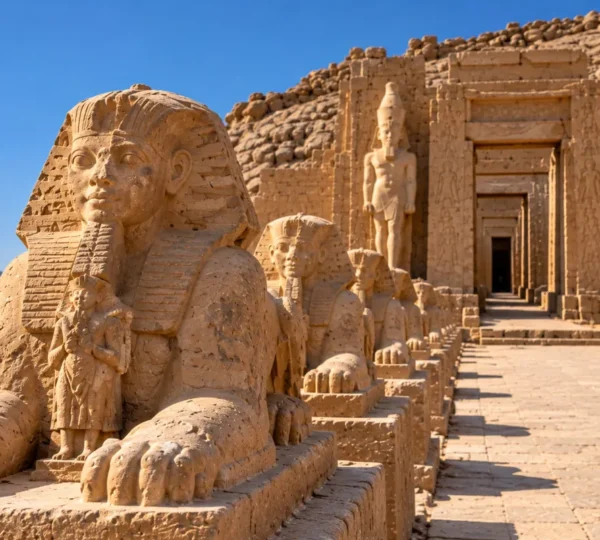
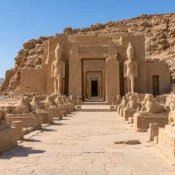
Illustrative image of a sphinx at the Temple of Wadi es-Sebua.
The Valley of the Lions: Sphinxes and Colossi
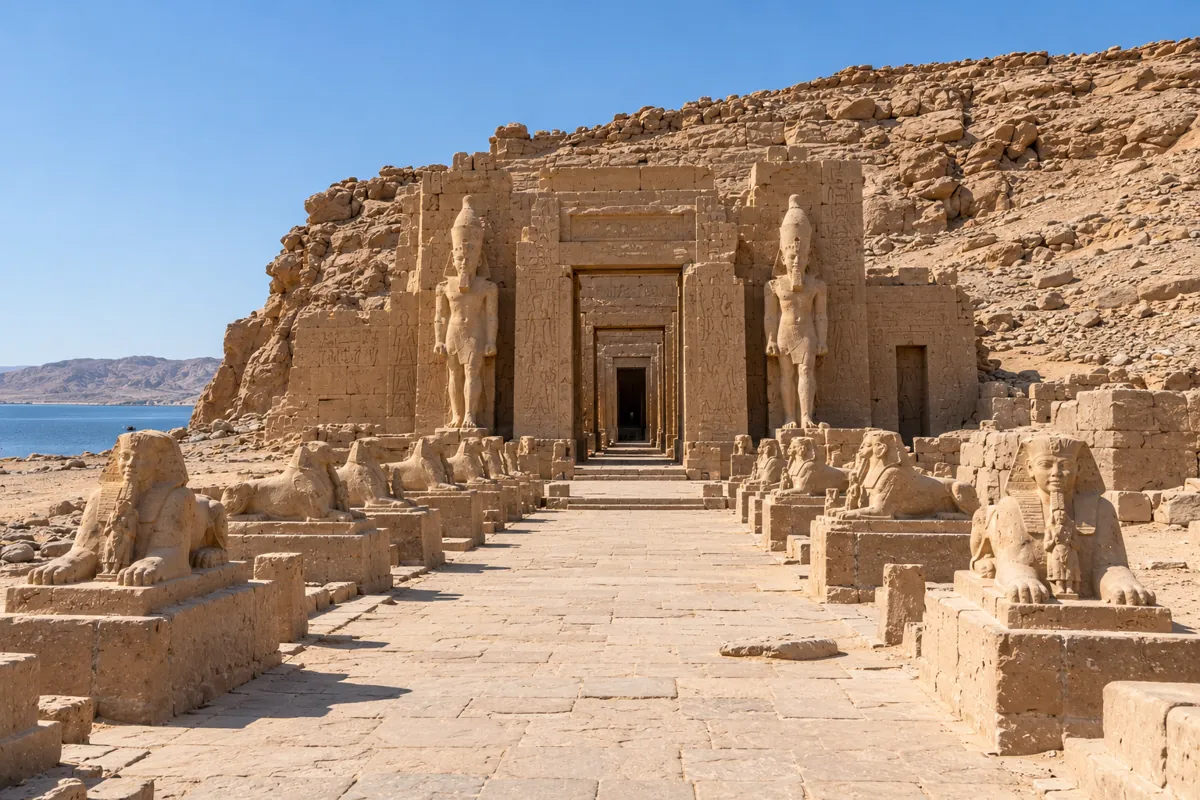
The temple once had three pylons. The first two were built of mud brick and have crumbled, leaving only the stone gateway passages. What remains is still dramatic:
- The first court: two human-headed sphinxes line the way, accompanied by statues of Ramesses II. Only the left-hand statue stands in place, while the other lies in the sand.
- The second court: four falcon-headed sphinxes represent forms of the god Horus. Each holds a small statuette of Ramesses II between its front legs.
- The third pylon: four colossal statues of the king once stood here, and only one remains upright. The pylon carries the classic scenes of the pharaoh smiting enemies and making offerings to the gods, including himself.
The Rock-Cut Sanctuary
Beyond the third pylon, the temple enters the cliff. A hall of 12 square pillars leads to an antechamber, two side rooms, two side chapels and the sanctuary itself. The central six pillars once carried statues of the king as Osiris. The statues in the sanctuary niches were destroyed, but scholars agree they represented Amun-Ra, Ra-Horakhty and Ramesses II.
On the walls, the offering scenes survive, and some still keep traces of their original color. In the sanctuary and its chapels, painted scenes show Ramesses II adoring the sacred boats of Amun-Ra and Ra-Horakhty.
From Temple to Church: The Saint Peter Painting
Wadi es-Sebua has a second story that surprises many visitors. After Nubia became Christian in the 6th century CE, the hall of the temple was converted into a church. The Osiride statues were chiseled away, and some of the reliefs were covered with plaster and painted with Christian images.
In the central niche, the statues of Amun and Ra-Horakhty were removed and replaced by a painting of Saint Peter. That plaster layer protected the older carvings underneath. When it was removed in the 19th century, it revealed an odd sight: Ramesses II appearing to offer flowers to Saint Peter. Few temples in Egypt show so clearly how one faith was layered over another.
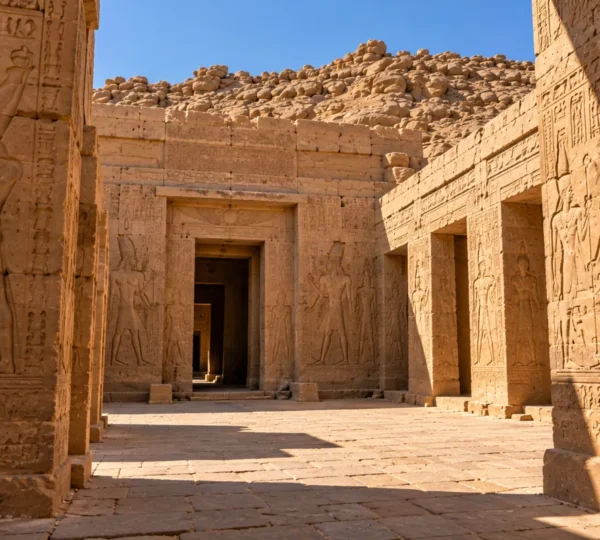
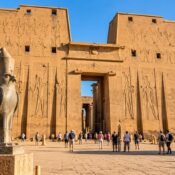
Illustrative view of the courtyard at the Temple of Wadi es-Sebua.
The Older Temple of Amenhotep III
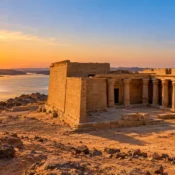
The first temple at the site was built by Amenhotep III. It began as a small rock-cut sanctuary, about 3 m by 2 m, fronted by a mud-brick pylon, a court and a hall. Images of Amun were attacked during the Amarna Period, and Ramesses II later restored and extended the building. It stood roughly 150 m from the larger temple and was not rescued, so it now lies under the lake.
Saved From Lake Nasser
When the Aswan High Dam was built, Lake Nasser threatened to cover Lower Nubia. UNESCO launched its International Campaign to Save the Monuments of Nubia, which ran from 1960 to 1980. The Egyptian Antiquities Service dismantled Wadi es-Sebua in 1964 with United States support, and it was rebuilt about 4 km west of its first location. Dakka and Maharraqa were moved to the same new site.
UNESCO lists Wadi es-Sebua among the five component parts of the Nubian Monuments property that contain temples moved during the campaign. Its assessment is that the care of the work means the form, design and spirit of these places remain authentic. The property was inscribed on the World Heritage List in 1979 under criteria (i), (iii) and (vi).
Why Visit Wadi es-Sebua?
You come here for a mix you rarely find in one place: a sphinx avenue, a sanctuary cut into living rock, a church inside a pharaonic hall, and a modern rescue story, all in open desert beside the lake with few other visitors. Next door, the Temple of Dakka and the Temple of Maharraqa let you see three monuments in one stop.
How to Get to Wadi es-Sebua: Private Visits by Lake Nasser Cruise
The usual way to reach Wadi es-Sebua is by Lake Nasser cruise. After visiting the Aswan High Dam, travelers board a cruise that sails south and stops at the Nubian temples along the shore. The stops include Wadi es-Sebua, Dakka, Maharraqa and Amada.
With Oceanus Tours & Travel, this is a private visit that covers Wadi es-Sebua, Dakka, Maharraqa and Amada together in one journey, so you travel with your own group at your own pace. Your Egyptologist guide stays with you throughout the trip and explains each temple as you reach it, from the sphinx avenue to the Saint Peter painting. Routes, schedules and access can change, so it is best to plan the cruise in advance with a team that knows the current options. See our Nile cruises and travel packages for more ideas.
Practical Tips for Visitors
- Best season: October to April brings milder temperatures. Summer heat in Lower Nubia is intense.
- Go early: morning light is better for photos, and the desert is cooler.
- Pack smart: sun hat, sunscreen, sturdy walking shoes and plenty of water.
Plan Your Visit With Oceanus Tours & Travel
Oceanus is a Luxor-based Egyptian travel company that plans private journeys across Egypt, including Aswan and Lower Nubia. Message us with your dates and group size, and we will build an itinerary around your interests.
Want to pair Nubia with the rest of Aswan? Take a look at our Aswan day tours, the Private Aswan Highlights Tour (High Dam, Philae Temple and the Unfinished Obelisk), or read our guides to Kalabsha Temple, Philae Temple and the Aswan travel guide.
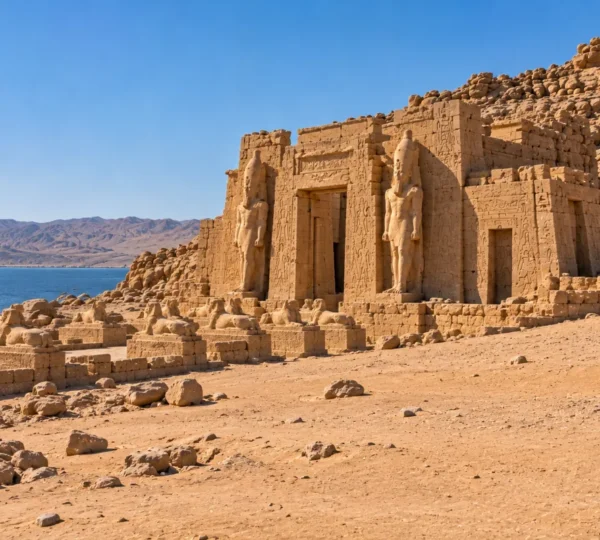
Illustrative front view of the Temple of Wadi es-Sebua.
Plan Your Trip
- Call / WhatsApp: (+20) 101 806 4111
- Email: info@oceanusluxor.com
- Contact form: oceanusluxor.com/contact
Frequently Asked Questions
Where is the Temple of Wadi es-Sebua located?
It is at New Wadi es-Sebua on the west bank of Lake Nasser in Lower Nubia, roughly 150 km south of Aswan.
What does Wadi es-Sebua mean?
It means “Valley of the Lions” in Arabic, a name inspired by the sphinxes that line the approach to the temple.
Who built the Temple of Wadi es-Sebua?
The main temple was built by Ramesses II, under the management of the viceroy of Kush, Setau. An earlier, smaller temple at the site was built by Amenhotep III.
Why was the temple moved?
The Aswan High Dam created Lake Nasser, which would have covered it. It was dismantled in 1964 and rebuilt about 4 km west as part of the UNESCO rescue campaign.
Why is there a painting of Saint Peter in an Egyptian temple?
After Nubia became Christian in the 6th century CE, the temple hall was turned into a church, and Christian images were painted over parts of the older reliefs.
How do I visit Wadi es-Sebua?
Most visitors reach it by Lake Nasser cruise after visiting the Aswan High Dam. The cruise also stops at Dakka, Maharraqa and Amada. Contact us to plan a private visit.
A Temple Built in Stone and Layered in Time
Wadi es-Sebua brings together a pharaoh’s ambition, a viceroy’s frontier project, a Christian church and a 20th-century rescue in one site. With Oceanus and your private guide beside you, it is a memorable chapter in any journey through Nubia.
Sources and Further Reading
- UNESCO World Heritage Centre, Nubian Monuments from Abu Simbel to Philae
- John Baines and Jaromír Málek, Atlas of Ancient Egypt (1982)
- Richard H. Wilkinson, The Complete Temples of Ancient Egypt (2003)
- Joyce Tyldesley, Ramesses: Egypt’s Greatest Pharaoh (2001)