
The Temple of Amada is the oldest surviving Egyptian temple in Nubia, and one of the most beautifully decorated. Built more than 3,400 years ago, it stands on the shore of Lake Nasser, far from the crowds of Aswan and Luxor. Its plain outer walls hide delicate painted reliefs that still hold their color. This guide explains who built the temple, what you see inside, how it was saved from the rising waters behind the High Dam, and how you can visit it together with the temples of Maharraqa, Dakka and Wadi es-Sebua on a special Lake Nasser cruise with Oceanus Tours & Travel.
Temple of Amada: Quick Facts
- Location: New Amada, on the shore of Lake Nasser, Lower Nubia, Egypt
- Period: 18th Dynasty, New Kingdom
- Builders: Thutmose III, Amenhotep II and Thutmose IV
- Dedicated to: Amun-Re and Re-Horakhty
- Moved: in the 1960s, in one piece on rails, to a site about 65 meters higher
- Recognition: part of the UNESCO World Heritage site “Nubian Monuments from Abu Simbel to Philae” (1979)
Who Built the Temple of Amada?
Pharaoh Thutmose III founded the temple in the 18th Dynasty and dedicated it to the gods Amun-Re and Re-Horakhty. His son and successor, Amenhotep II, continued the decoration of the building. The next king, Thutmose IV, added the pillared hall. In total, three generations of pharaohs worked on the temple.
Later rulers left their marks too. Seti I and Ramesses II carried out minor restorations and added to the decoration, and stelae of high officials describe building work under Ramesses II, Merenptah and Siptah. Temples like Amada were more than places of worship. They also showed Egypt’s religious and administrative presence in Nubia during the New Kingdom.
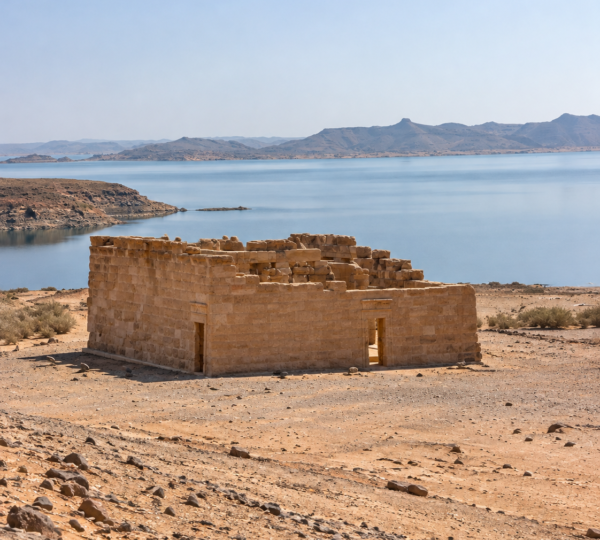
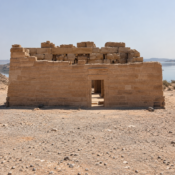
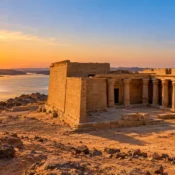
view of the Temple of Amada and Lake Nasser.
Layout and Architecture
The original plan was simple and classic: a pylon (monumental gateway), an open forecourt, and a portico leading to the sanctuary. Thutmose IV later roofed the open forecourt and turned it into a pillared hall. Its walls and pillars carry offering scenes, with Thutmose IV shown on the left and Thutmose III and Amenhotep II on the right.
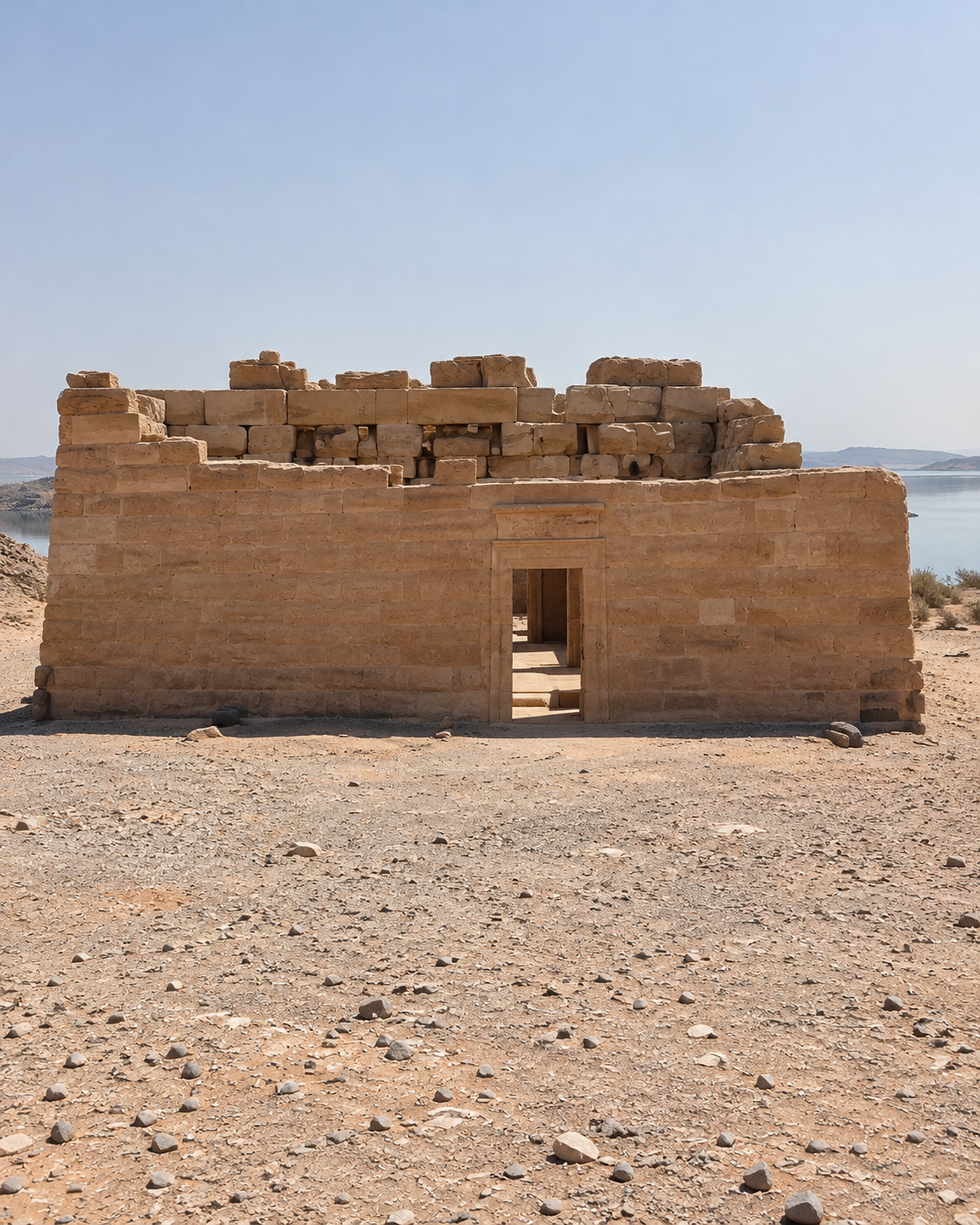
From the outside, Amada looks modest. The exterior walls are weathered and crumbling, and the building is small compared with giants such as Karnak or Abu Simbel. The real treasure is inside.
The Painted Reliefs of Amada
The interior of Amada holds some of the finest painted reliefs in Nubia, cut with great care and still showing bright, vibrant color. The best examples are in the innermost part of the temple, where Thutmose III and Amenhotep II are shown being embraced by gods or presenting offerings to them.
In the vestibule, one scene shows Amenhotep II being crowned by the gods Horus and Thoth. Another shows the king running with an oar and a hap, a ritual object linked to navigation. A cult room beside the sanctuary preserves foundation scenes, including the ritual of “stretching the cord,” the making and laying of bricks, and the offering of the finished temple to its gods. Together they show how the ancient Egyptians believed a temple was founded.
Historical Inscriptions at Amada
Amada also holds two important historical texts. The earlier one is a round-topped stela on the rear (eastern) wall of the sanctuary, dated to Year 3 of Amenhotep II. It tells of the king’s campaign in Asia and says he brought back defeated chiefs. Six were hung on the walls of Thebes, and one was displayed at Napata in Nubia as a warning to anyone planning a rebellion.
The temple also preserves inscriptions about the military exploits of Merenptah, a pharaoh of the 19th Dynasty. Together, these texts make Amada a valuable source for the history of Egypt’s relations with Nubia and the Near East.
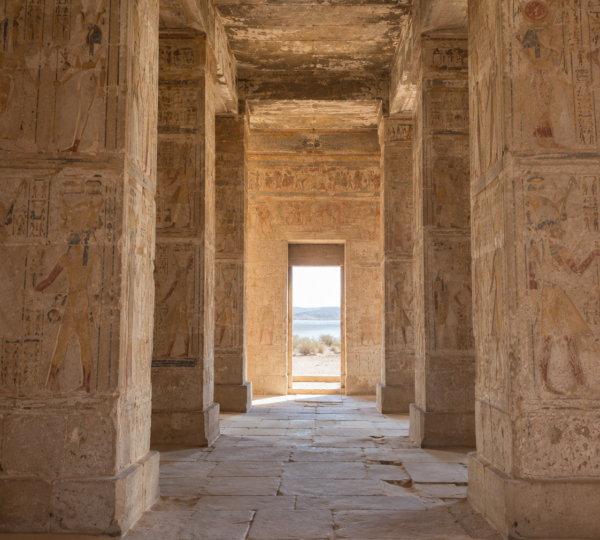
view of the pillared hall added by Thutmose IV
From Temple to Church
The temple’s story did not end with the pharaohs. During the Amarna period, Akhenaten had the name of Amun removed from the temple. Seti I later restored it. In late antiquity the building was converted into a church, and early travelers still saw a dome from this period when they visited in the 19th century. The temple was first published in detail by the French Egyptologist Henri Gauthier in his book Le temple d’Amada (Cairo, 1913).
How the Temple of Amada Was Saved
When the Aswan High Dam was built, the rising waters of Lake Nasser threatened to flood Lower Nubia, including Amada. Other temples were cut into blocks and rebuilt, but that method was too risky for Amada because its fragile painted reliefs would not have survived cutting.
The French Egyptologist Christiane Desroches Noblecourt announced that France would help save the temple, and engineers designed a plan to move it intact. After the Egyptian Antiquities Service dismantled the facade, the rest of the building was braced with steel bands, cut free from the ground, and placed on three railroad tracks. On 12 December 1964, hydraulic jacks began pushing the temple up a steep incline. As the temple moved forward, the rails behind it were taken up and laid again in front. The temple traveled about 2.5 kilometers and ended up roughly 65 meters higher than its original site. The whole operation was one of the most remarkable feats of the international campaign to save the monuments of Nubia.
Today the temple stands at New Amada, and the group of Nubian monuments from Abu Simbel to Philae has been on the UNESCO World Heritage List since 1979.
New Amada: The Temple of Derr and the Tomb of Pennut
Amada did not move alone. The rock-cut Temple of Derr, built by Ramesses II, was moved from the opposite bank of the Nile and re-erected beside it. The tomb of Pennut, a Deputy of Wawat (the ancient name for Lower Nubia), was also relocated to New Amada. The result is a small cluster of rescued monuments in a quiet, empty desert setting that is close to what the ancient landscape must have felt like.
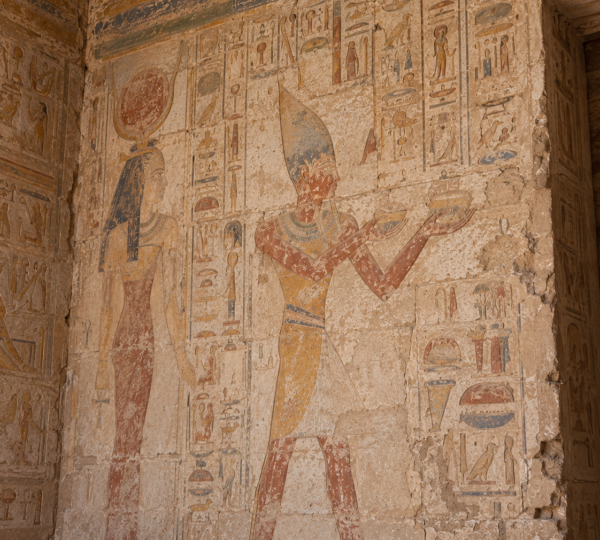
image of the painted reliefs of the Temple of Amada.
Wadi es-Sebua, Dakka and Maharraqa
Three more temples were rebuilt at New Wadi es-Sebua, about 4 kilometers west of their original location, and they make a natural pair with Amada.
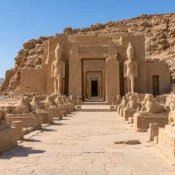
Temple of Wadi es-Sebua. The name means “Valley of the Lions,” and the temple is approached by an avenue of sphinxes. It was built by Ramesses II and dedicated to Amun-Re, with a sandstone front and a rock-cut sanctuary at the back. The court is decorated with reliefs of Ramesses II and processions of his children. An earlier temple on the site was begun under Amenhotep III.
Temple of Dakka. This Greco-Roman temple is dedicated to Thoth of Pnubs, the god of wisdom. It was built and expanded over centuries by Meroitic, Ptolemaic and Roman rulers. Its sandstone pylon is about 24 meters wide and 12 meters high.
Temple of Maharraqa. This small Roman-period temple was dedicated to Isis and Serapis and was never completed. Only its court, surrounded by columns on three sides, was finished. Its most unusual feature is a spiral staircase that once led to the roof, the only one of its kind among the temples of Nubia. The temple was dismantled in 1961 and rebuilt in 1966 together with Dakka.
Visit Amada, Maharraqa, Dakka and Wadi es-Sebua with Oceanus Tours & Travel
These temples lie on the shores of Lake Nasser, beyond the High Dam and away from the usual Aswan sightseeing circuit. That is why most visitors reach them on a Lake Nasser cruise. At Oceanus Tours & Travel, the Temple of Amada, the Temple of Maharraqa, the Temple of Dakka and the Temple of Wadi es-Sebua are offered as a special trip with its own dedicated cruise, starting from behind the High Dam. Our guide travels with you throughout the trip and explains the history, the reliefs and the rescue story of each temple as you visit.
The trip suits travelers who have already seen Philae and Abu Simbel and want a quieter, less crowded side of Nubia. To make the most of it, wear a hat and comfortable shoes, use sun protection, and bring drinking water, since the temples stand in open desert.
Contact Oceanus Tours & Travel to plan your Lake Nasser temples cruise.
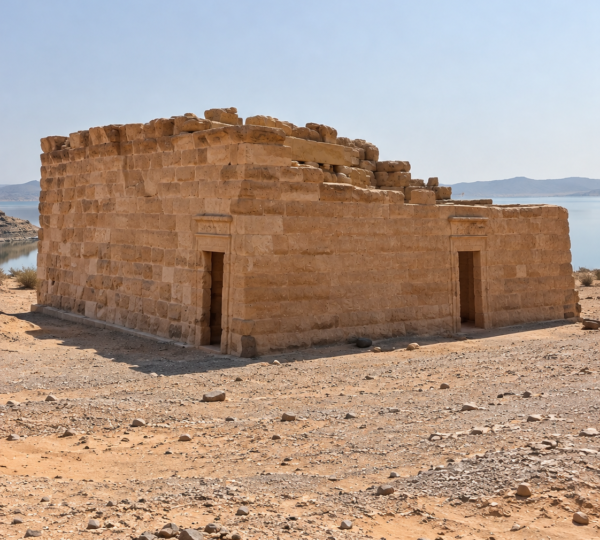
Illustrative view of the Temple of Amada and its desert setting.
Temple of Amada: Frequently Asked Questions
What is the Temple of Amada famous for?
It is the oldest surviving Egyptian temple in Nubia and is known for its finely cut painted reliefs and its historical inscriptions. It is also famous for being moved in one piece on rails in the 1960s.
Who built the Temple of Amada?
Thutmose III began it, Amenhotep II continued the decoration, and Thutmose IV added the pillared hall. All three ruled during the 18th Dynasty.
Why was the Temple of Amada moved?
The construction of the Aswan High Dam created Lake Nasser, whose rising waters would have flooded the temple at its original site.
Can I visit Amada, Maharraqa, Dakka and Wadi es-Sebua together?
Yes. With Oceanus Tours & Travel, the four temples are visited on one special trip with a dedicated Lake Nasser cruise from behind the High Dam, accompanied by our guide.
Is the Temple of Amada a UNESCO World Heritage site?
Yes. It is part of the “Nubian Monuments from Abu Simbel to Philae,” inscribed on the UNESCO World Heritage List in 1979.
Book Your Lake Nasser Temples Cruise
Ready to visit Amada, Maharraqa, Dakka and Wadi es-Sebua with our guide? Contact Oceanus Tours & Travel:
- Phone: (+20) 101 806 4111
- Email: info@oceanusluxor.com
- Website: oceanusluxor.com/