
The Temple of Derr is a rock-cut temple built by Ramesses II in Lower Nubia and now standing at New Amada, near Lake Nasser. A speos is a temple cut into natural rock, and Derr’s carved halls link ancient Egyptian religion with the history of Nubia.
The temple was dismantled in 1964 and rebuilt on higher ground when the Aswan High Dam threatened to flood its original site. Today it stands near the Temple of Amada, far from the riverbank where it first stood.
This guide explains who built the temple, how its halls and sanctuary are arranged, what the reliefs show, how the temple was saved, and what to expect when you visit.
Key Takeaways
- Built by Ramesses II in the 19th Dynasty
- The only rock-cut temple he built on the east bank of the Nile in Nubia
- Two hypostyle halls lead to a sanctuary with four cult statues
- Dismantled and moved in 1964 to New Amada
- Now stands near the Temple of Amada on Lake Nasser
Where Is the Temple of Derr, and Who Built It?
The temple now stands at New Amada, near the Temple of Amada, on the shore of Lake Nasser. It originally stood at el-Derr, on the east bank of the Nile in Lower Nubia.
Pharaoh Ramesses II built the temple during the 19th Dynasty. It is the only rock-cut temple in Nubia that he built on the east bank of the Nile. In ancient times it was known as “The Temple of Ramesses, Beloved of Amun, in the Domain of Re,” and it was dedicated to the god Ra-Horakhty.
Scholars disagree on the exact date. Some date it to Year 30 of Ramesses II, possibly to mark his first royal jubilee, while others place it in the second half of his reign. Either way, the temple belongs to the reign of Ramesses II, whose building projects reached across Egypt and Nubia.
Derr is also more elaborate than the rock-cut temple of Beit el-Wali, another Nubian monument of Ramesses II. Its position on the eastern bank sets it apart from his other rock-cut temples in Nubia.
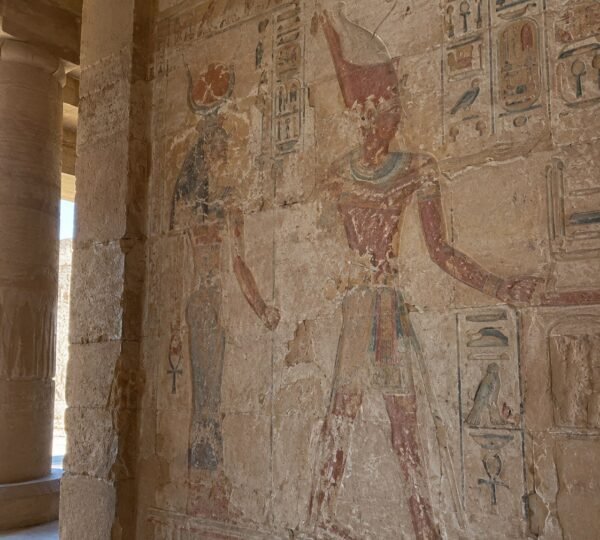
image of the colored reliefs of the Temple of Derr.
What Makes Its Rock-Cut Layout Distinct?
Visitors move inward through two hypostyle halls before reaching a triple sanctuary at the rear. A hypostyle hall is a large room supported by columns.
The route through the halls
The halls form the main path through the temple. Their columns and carved surfaces guide the eye toward the sanctuary instead of toward an open court. This inward route is the temple’s defining feature, and it helps explain how worshippers approached the most sacred area.
The triple sanctuary
The sanctuary contains cult statues of Ramesses II, Amun-Re, Ra-Horakhty and Ptah, cut into the rock. The group places the deified king beside major gods, and the decoration around it supports that message.
A design compared with Abu Simbel
The plan and decoration resemble the Great Temple of Abu Simbel, another monument of Ramesses II. Both have rock-cut rooms, and both show the same four gods in the sanctuary. The main difference is the front: at Abu Simbel, colossal seated statues dominate the facade, while Derr has none. Inside, Derr’s sequence of halls leads steadily toward the sanctuary and gives the visit a different sense of scale.
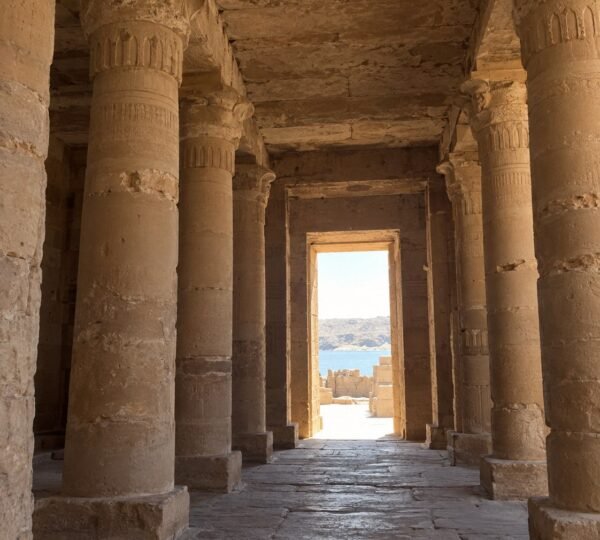
view of a pillared hall of the Temple of Derr.
What Do the Reliefs and Inscriptions Show?
Some scenes in the first pillared hall show military campaigns of Ramesses II, but most of the wall decoration shows the king with the gods, performing temple rituals.
Royal campaigns and temple ritual
The campaign scenes show the king in a military role. Across the rest of the walls, the larger theme is his relationship with the gods through ritual acts. The images link kingship with religious duty, so the temple reads as both a royal monument and a place of worship.
Color and preserved decoration
The reliefs in the second pillared hall have kept their colors very well. Look closely at the carved surfaces to see how color adds detail to the figures. The decoration supports the same themes as the halls and the sanctuary: kingship, worship and the gods.
How Was the Temple Rescued and Relocated?
When the Aswan High Dam was built, the rising waters of Lake Nasser threatened to flood the temple’s original site. The temple was dismantled in 1964 and moved to a new site.
The threat from the rising waters
The dam created Lake Nasser and put many Nubian temples at risk. Without action, the water would have covered the temple and its carved rooms. The rescue was part of the International Campaign to Save the Monuments of Nubia, led by UNESCO.
The move to New Amada
The temple was taken apart and rebuilt at New Amada, where it now stands near the relocated Temple of Amada. The new site keeps it above the lake. Earlier in its history, the temple had been turned into a church, which adds another layer to its long use.
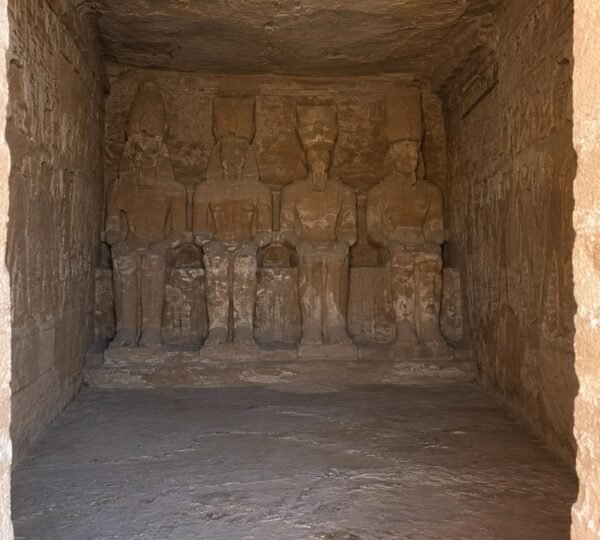
view of the sanctuary of the Temple of Derr, where cult statues of Ramesses II and the gods were cut into the rock.
Derr, Amada and the Rescued Temples of Lower Nubia
New Amada is one of the most important clusters of rescued Nubian monuments. Its main temple is the Temple of Amada, the oldest surviving Egyptian temple in Nubia. Thutmose III founded it in the 18th Dynasty, Amenhotep II continued its decoration, and Thutmose IV added the pillared hall. The tomb of Pennut, a Deputy of Wawat (the ancient name for Lower Nubia), also stands at New Amada.
The Temple of Amada was moved in one piece on rails, about 2.5 kilometers and roughly 65 meters higher than its original site, in an operation that began on 12 December 1964. Derr was dismantled in the same year and rebuilt beside it.
Other temples were saved nearby. The Temple of Wadi es-Sebua, approached by an avenue of sphinxes, was built by Ramesses II and dedicated to Amun-Re, Ra-Horakhty and the deified king. The Temple of Dakka, dedicated to Thoth of Pnubs, and the small Roman-period Temple of Maharraqa, dedicated to Isis and Serapis, were moved and rebuilt at the same new site as Wadi es-Sebua. Seen together, these monuments show how the campaign saved a whole group of temples and not just one building.
What Can Visitors See and Plan For?
Start at the entrance, then follow the route inward through the two halls to the sanctuary, and take your time in each room.
What you will see
Visitors see the front of the temple, the two halls, the sanctuary and the carved decoration. Look at the reliefs from more than one position, since the scenes are easier to follow when you notice how they relate to the room around them. The setting at New Amada is part of the visit. This is a relocated monument, and its present site differs from its original riverbank.
Visiting with a guide
New Amada lies on the shore of Lake Nasser, away from the main sights of Aswan. A guide helps explain the design, the reliefs and the story of the rescue without rushing you through the halls. Follow the site rules and any limits on access during your visit.
Conclusion
The Temple of Derr rewards careful attention. Its rock-cut halls, its sanctuary of four statues and the story of its rescue all tell a piece of Nubian history. Oceanus Tours & Travel offers a guided trip to this temple with our own guide.
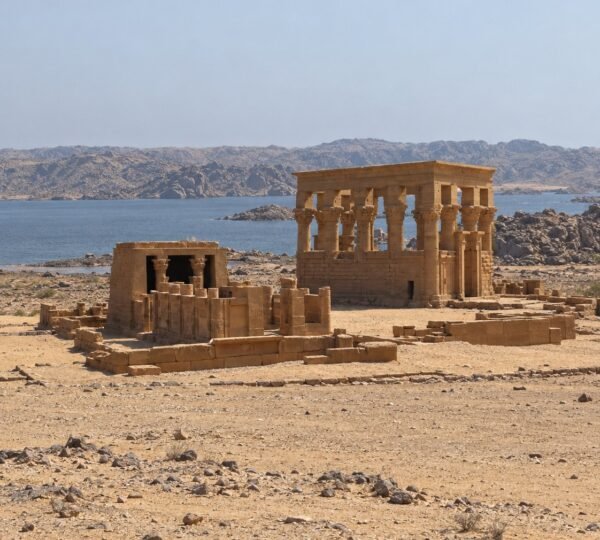
view of the Temple of Derr near Lake Nasser.
FAQ
Where is the Temple of Derr located?
The temple now stands at New Amada, near the Temple of Amada, on Lake Nasser. It originally stood at el-Derr on the east bank of the Nile and was moved in 1964.
Who built the Temple of Derr and when?
Ramesses II built it during the 19th Dynasty. Scholars disagree on the exact date: some place it in Year 30 of his reign, others in the second half of his reign.
Which gods is the Temple of Derr dedicated to?
The temple was dedicated to Ra-Horakhty. Its sanctuary also holds cult statues of Ramesses II, Amun-Re and Ptah.
Can I visit the Temple of Derr and the Temple of Amada on the same trip?
Yes. Both temples stand near each other at New Amada, so they are easy to visit together.
Is the Temple of Derr open to visitors?
Yes. It is a visitor site with opening hours and ticket prices listed by Egypt’s Ministry of Tourism and Antiquities.
Visit the Lake Nasser Temples with Oceanus Tours & Travel
Every temple in this guide can be part of your trip with Oceanus Tours & Travel. We offer a special trip to the Temple of Amada, the Temple of Maharraqa, the Temple of Dakka and the Temple of Wadi es-Sebua, with its own dedicated Lake Nasser cruise starting from behind the High Dam. Our own guide travels with you and explains the history, the reliefs and the story of the rescue at every stop. If you would like the Temple of Derr to be part of your plan, tell our team and we will help you arrange it.
Explore our Aswan tours or contact us to plan your trip.
Phone: (+20) 101 806 4111
Email: info@oceanusluxor.com
Website: oceanusluxor.com