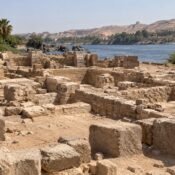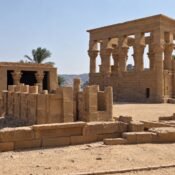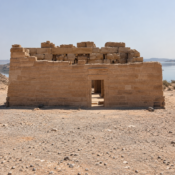

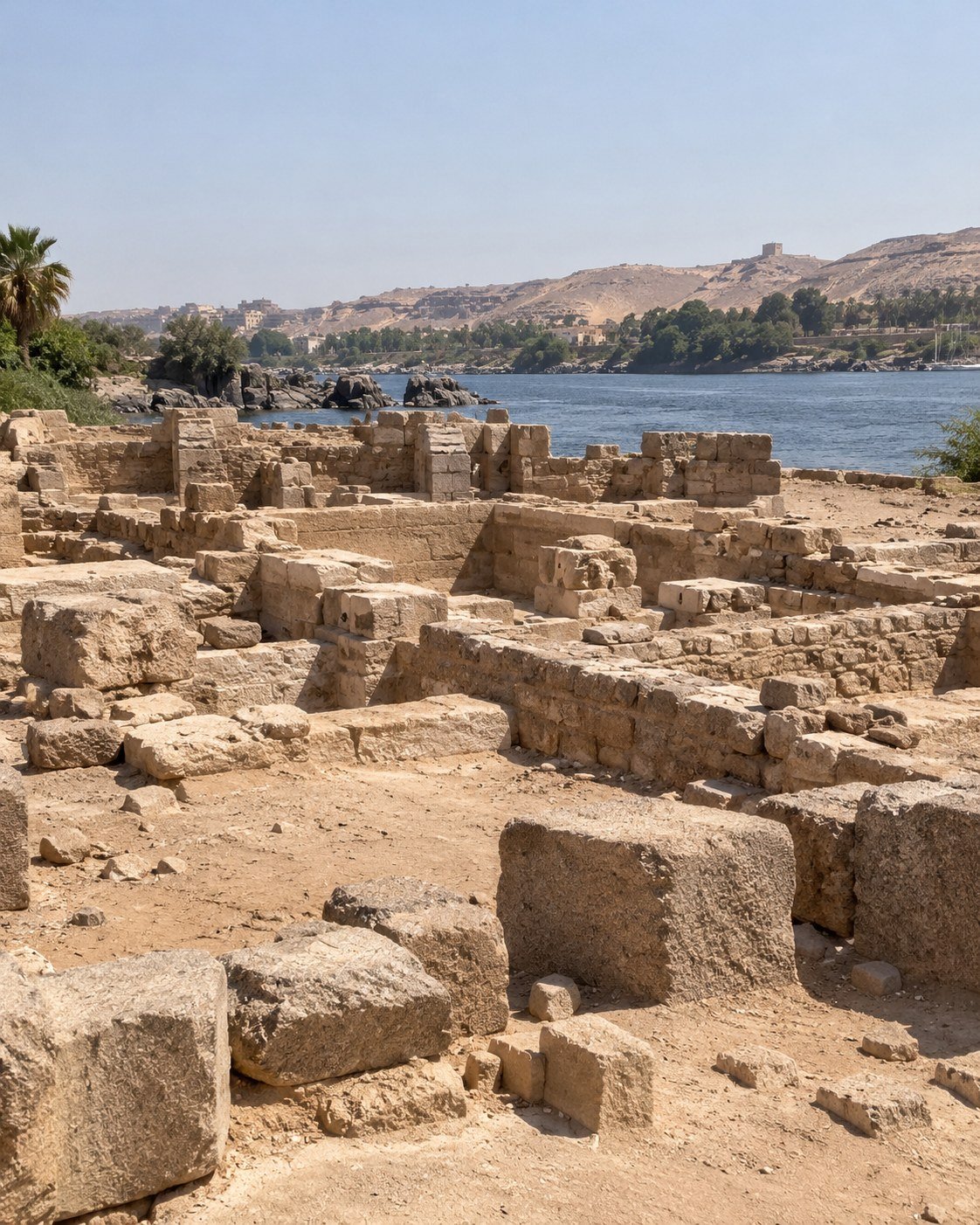
Elephantine Island Temples stand amid a striking contrast: Aswan’s bright Nile River and the weathered remains of ancient Egypt. The river still shapes the view, while the island holds traces of worship, daily life, and long change. Visitors can learn from sanctuaries, a Nilometer, the Aswan Museum, and scattered archaeological remains. A Nilometer is a structure used to measure the Nile’s water level, including the height of its annual flood.
The island is not only an archaeological site. Nubian communities live here, and their villages remain part of the island’s present-day character. Its appeal lies in seeing ancient remains beside a living river community. We can approach the visit as both a journey into the past and a chance to notice how people inhabit the landscape today.
We will follow a practical route through the island’s history and sights, from its position beside Aswan to its sacred buildings and village setting.
Key Takeaways
- Elephantine sits in the Nile beside Aswan, just downstream of the First Cataract
- Its sanctuaries honored Khnum, Satet and Anuket
- The oldest standing ruins include a Third Dynasty granite step pyramid
- Two Nilometers recorded the Nile’s water levels
- The site is part of the UNESCO World Heritage site “Nubian Monuments from Abu Simbel to Philae” (1979)
- Nubian villages and archaeological remains share the island today
Where Is Elephantine Island in Aswan?
Elephantine Island lies in the Nile beside Aswan, just downstream of the First Cataract, on the historic border between Upper Egypt and Lower Nubia. The city’s riverfront faces the island, so it is easy to reach and easy to place in the river landscape.
The island is about 1,200 meters long from north to south and about 400 meters wide at its broadest point. Its ancient name, Abu or Yebu, means “elephant.” The Aswan Museum stands on the island, close to the archaeological area.
The archaeological site of Elephantine has been part of the UNESCO World Heritage site “Nubian Monuments from Abu Simbel to Philae” since 1979. From the island you can see the river, Aswan’s riverfront and the desert beyond, and the view changes with the light.
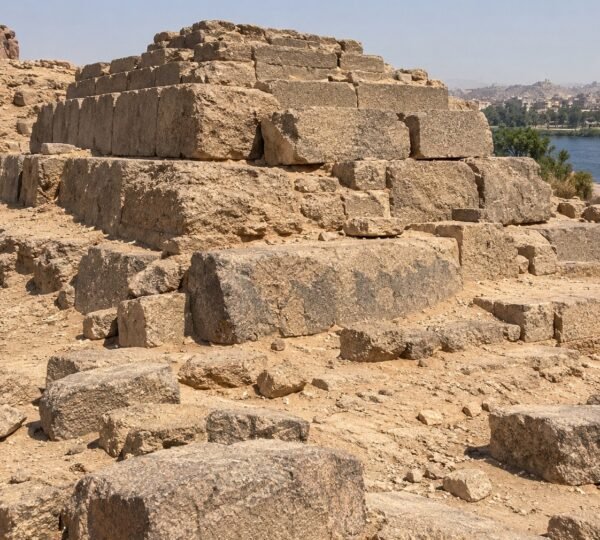
image of the step pyramid ruin on Elephantine Island.
Why Did Elephantine Island Matter to Ancient Egypt?
Elephantine stood at the First Cataract, a rocky stretch of the Nile where boats could not pass freely. That made it a natural meeting point for river traffic and for goods arriving from the south, and an important center for exchange and control on Egypt’s southern frontier.
A southern checkpoint for trade
Goods and people moving between Nubia and Egypt had to pass through a managed crossing at the cataract. Ivory was among the goods associated with this trade, and granite from the region served Egyptian building projects.
A strategic border settlement
The island’s position beside a difficult stretch of river, on the boundary between Egypt and Nubia, made it a strategic settlement where trade and administration met. The ancient name Abu or Yebu means “elephant.” The meaning is recorded, but it does not prove why the island received that name.
Which Gods Were Worshipped on Elephantine Island?
Elephantine was the center of worship of Khnum, his consort Satet and their daughter Anuket, a divine family linked to the Nile and its waters.
Khnum, the creator god
Khnum, the ram-headed god, was worshipped here as a creator god and as the guardian of the Nile’s waters at the cataract. A mummified ram of Khnum, found on the island, is displayed in the Aswan Museum.
Satet, the goddess linked to the flood
Satet was linked with the Nile’s annual inundation, the yearly rise of the river that shaped farming and daily life. The Temple of Satet is the oldest known temple on the island, with a history that reaches back to about 3000 BCE.
Anuket and the Elephantine Triad
Anuket was the daughter of Khnum and Satet and was also associated with the Nile. Together, the three deities are often called the Elephantine Triad.
What Are the Elephantine Island Temples?
The archaeological remains include the Temple of Satet and the Temple of Khnum, along with other chambers, gateways and courtyards. They are traces of buildings that changed over time, not a single complete complex, so visitors see foundations and partial walls rather than intact temples.
The two best-known sanctuaries are the Temple of Satet, founded around 3000 BCE, and the Temple of Khnum, whose ruins take up most of the island’s southern tip. The southern tip also holds a granite step pyramid from the Third Dynasty, the oldest ruin still standing on the island.
A visitor may recognize a plan or a line of stone without seeing a roof or every room. The open archaeological area invites you to read the fragments and imagine how the buildings once worked.
image of the step pyramid ruin on Elephantine Island.
How Did the Temple of Satet Develop?
The Temple of Satet was the first temple on the island, founded around 3000 BCE. It was enlarged and renovated over the next 3,000 years, so the remains belong to many different periods.
An early sanctuary on the island
The sanctuary was dedicated to Satet, the goddess linked to the Nile’s inundation. Its early date places worship at this site near the beginning of ancient Egyptian history.
Rebuilding and continued worship
A temple of Satet stood on the island in the Middle Kingdom. In the New Kingdom it was rebuilt under Queen Hatshepsut and enlarged by Thutmose III. There are indications of further work in the 26th Dynasty, but very little of that temple has survived.
What Can Visitors See at the Temple of Khnum?
The ruins of the Temple of Khnum take up most of the island’s southern tip. There are records of a temple to Khnum on the island as early as the Third Dynasty, and the temple was completely rebuilt in the Thirtieth Dynasty, shortly before the Greco-Roman Period.
The oldest ruins on the island
The oldest ruins still standing here are a granite step pyramid from the Third Dynasty and a small temple built for Heqaib, a local nomarch of the Sixth Dynasty. In the Middle Kingdom, officials such as the local governors Sarenput I and Heqaib III dedicated statues and shrines in the temple.
Reading a ruined sanctuary
Look for the temple’s layout in the foundations, the stone blocks and the arrangement of the rooms. This is the Temple of Khnum on Elephantine, a different site from the Temple of Khnum at Esna.
What Do the Temple Reliefs and Inscriptions Reveal?
Elephantine’s written record is richer than its temple walls. The island is famous for the Aramaic papyri and ostraca found there between 1893 and 1910, which include legal documents and letters.
A rare calendar known as the Elephantine Calendar of Things, dating to the reign of Thutmose III, was also found in fragments on the island. Together with reliefs and inscribed objects, these finds show how the temples were decorated and who used them.
How Did the Nilometers Track the Nile’s Floods?
A Nilometer recorded the Nile’s water level, including the level of the annual flood. Elephantine has two Nilometers.
Stone steps leading to the river
The best-known is a corridor Nilometer associated with the Temple of Satet. Stairs cut into the rock lead down to the water, and its markings use Arabic, Roman and Pharaonic numerals, which shows it was used across different periods. The other is a rectangular basin at the island’s southern tip, near the Temple of Khnum.
Why water levels mattered
The annual flood affected farming along the river. A record of the Nile’s height helped people understand how much water had reached the valley and what that might mean for the harvest.
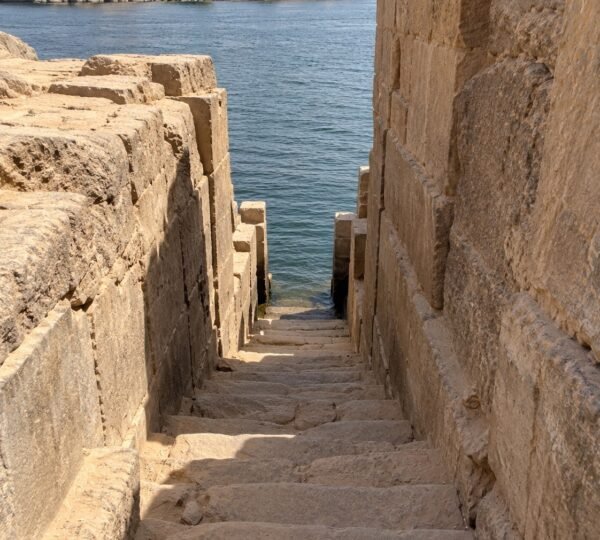
image of the Nilometer stairs on Elephantine Island.
What Happened to Other Temples and Sacred Sites?
Before 1822, temples of Thutmose III and Amenhotep III stood on Elephantine Island. They were destroyed in 1822, during the time of Muhammad Ali’s campaign to conquer Sudan, and their stones were reused in new buildings.
A study based on drawings by early travelers describes the Amenhotep III building as a small chapel for the sacred boat, probably built for his second jubilee, and mentions a similar ruined chapel built by Seti I or Ramesses II. No trace of either remains on the ground today.
What Can You See at the Aswan Museum?
The Aswan Museum stands on the island and has been open to the public since 1912. A second section, opened in 1990, displays objects found on Elephantine itself.
Displays from the island’s excavations
The collection includes pottery, mummies, weapons and utensils. One notable item is a mummified ram of Khnum, found during excavations by the German Archaeological Institute.
The museum in your visit
Seeing objects indoors helps connect the ruins outside with the people who made and used these things. A pot or a tool can make daily life feel more immediate than a broken wall alone.
What Does Elephantine’s Jewish History Tell Us?
A Jewish community lived on Elephantine Island in the fifth century BCE and maintained its own temple. The Aramaic papyri found on the island document a community of Judean soldiers and their families who served under Persian rule.
According to the papyri, the temple was later destroyed in a riot led by priests of Khnum. This history shows that Elephantine’s past did not belong to one religious tradition alone.
How Does Nubian Life Shape Elephantine Island Today?
Ancient stone remains stand beside active village life on Elephantine Island. The Nubian villages of Siou and Koti are part of the island’s present-day setting, and palm groves and river scenery shape the views between the built areas.
These are living communities, not museums. Treat homes and community spaces with respect, and ask before photographing residents.
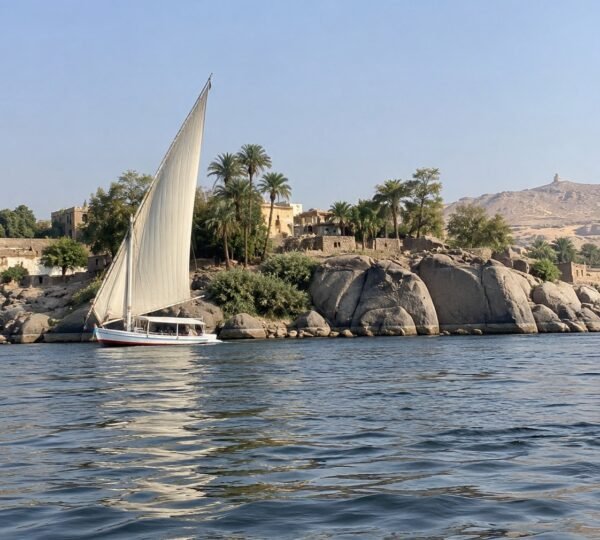
image of a felucca on the Nile at Elephantine Island.
How Can You Reach Elephantine Island?
Visitors cross the Nile from Aswan by local ferry or motorboat. The crossing is short, and the river is part of the experience: from the boat you can watch the city recede and the island come into view.
A felucca offers a slower, sailing crossing. A guide can help connect the scattered remains with their history, so you understand how the separate sites fit together.
When Is the Best Time to Visit Elephantine Island?
October through April is generally the most comfortable season for exploring Elephantine. Mornings are cooler, and late afternoon brings softer light over the river and the stone remains. In summer the heat can be strong, so plan your visit for the early morning.
How Can You Plan a Practical Visit to the Island?
The archaeological area, with the temple ruins and the Aswan Museum, is spread across the island, so one stop cannot explain the whole place. A map of the island helps you place the main remains and see how far apart they are.
Leave time for the Aswan Museum as well as the open-air ruins, and for the Nubian village. A guide adds context to features that might otherwise look like scattered stones.
Conclusion
Elephantine offers a distinctive way to see Aswan’s ancient history beside the Nile. Its sanctuaries, its step pyramid, its Nilometers and its museum show how many periods are layered on one island, which today is also home to Nubian villages.
Oceanus Tours & Travel can arrange a trip to Elephantine Island with our own vehicles or on our own Nile cruise, with our own guide.
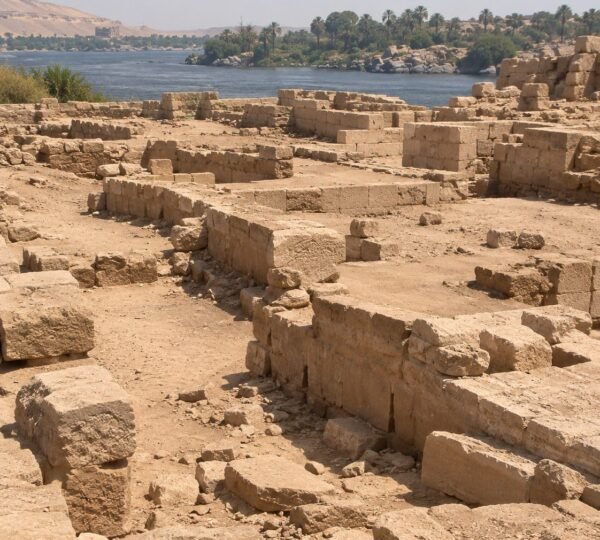
image of the Temple of Satet ruins.
FAQ
What does the word “elephantine” mean?
The ancient name of the island, Abu or Yebu, means “elephant.” The meaning is recorded, but it does not prove whether the name refers to the island’s shape or to the ivory trade.
Where is the island of Elephantine?
Elephantine Island sits in the Nile beside Aswan, just downstream of the First Cataract, on the historic border between Upper Egypt and Lower Nubia.
How big is Elephantine Island?
The island is about 1,200 meters long from north to south and about 400 meters wide at its broadest point.
Is Elephantine Island a UNESCO World Heritage site?
Yes. Its archaeological site has been part of the UNESCO World Heritage site “Nubian Monuments from Abu Simbel to Philae” since 1979.
Is there a pyramid on Elephantine Island?
Yes. The ruins at the southern tip include a small granite step pyramid from the Third Dynasty, the oldest ruin still standing on the island.
What is a Nilometer?
A Nilometer is a structure used to measure the Nile’s water level, including the height of its annual flood. Elephantine has two.
Visit Elephantine Island with Oceanus Tours & Travel
Oceanus Tours & Travel can arrange a trip to Elephantine Island with our own vehicles or on our own Nile cruise. Our own guide travels with you and explains the temples, the Nilometer and the island’s history as you visit.
Explore our Aswan tours or contact us to plan your trip.
Phone: (+20) 101 806 4111
Email: info@oceanusluxor.com
Website: oceanusluxor.com
Read more: Aswan travel guide