
The Aswan High Dam, often simply called the Aswan Dam, is a rock-fill embankment dam on the Nile in southern Egypt, built between 1960 and 1970. It holds back the river’s water in Lake Nasser, produces hydroelectric power, and protects farmland from both floods and drought. It also displaced about 100,000 people and set off one of the largest heritage rescues in history. This guide covers why Egypt built the High Dam Aswan visitors see today, its key facts, its costs and benefits, and how to visit it on a private trip with Oceanus Tours & Travel.
Why Was the Aswan High Dam Built?
Before the High Dam, the Nile swung between destructive floods and years of low water. The Old Aswan Dam, completed in 1902 and raised in 1907-1912 and 1929-1933, gave some control. It stands about 6 km downstream of the High Dam, but its storage was too small to manage the river’s largest swings.
The High Dam was designed to store water in high-flow years, release it when downstream users needed it, support irrigation and generate electricity. Water sharing was settled in the Egypt-Sudan agreement signed on 8 November 1959. It counted the Nile’s average annual flow at Aswan as about 84 billion cubic meters, set aside about 10 billion for evaporation, and divided the rest: 55.5 billion for Egypt and 18.5 billion for Sudan.
Who Paid for It, and How Was It Built?
Funding became a Cold War story. On 19 July 1956, the United States announced that its offer of aid was “not feasible in present circumstances,” and the World Bank also withdrew its support that year. The Soviet Union stepped in. Soviet credits of about US$425 million, extended in stages from 1958, covered the project’s foreign-exchange costs. The total cost was about E£450 million, including subsidiary projects and power lines.
Construction began on 9 January 1960. In May 1964, the Nile was diverted through a channel and tunnels so crews could build across the riverbed, and the reservoir began to fill that year. The power station produced its first electricity in 1967, the dam was completed in July 1970, and it was inaugurated in January 1971. The Soviet engineer Nikolai Malyshev of the Hydroproject Institute in Moscow designed it, Arab Contractors led the Egyptian side, and about 25,000 Egyptian engineers and workers took part.
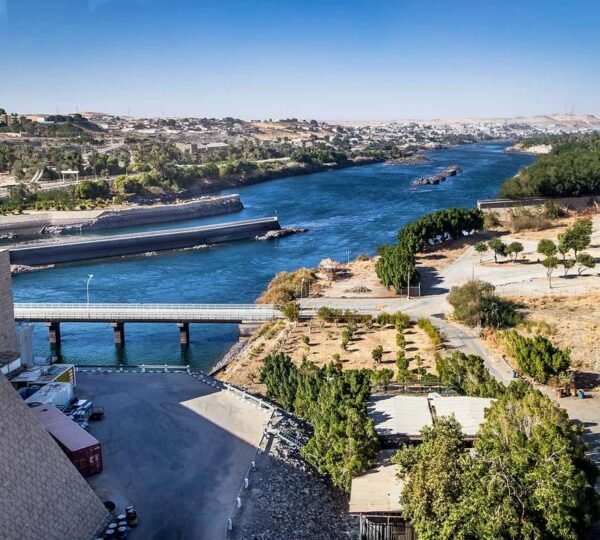
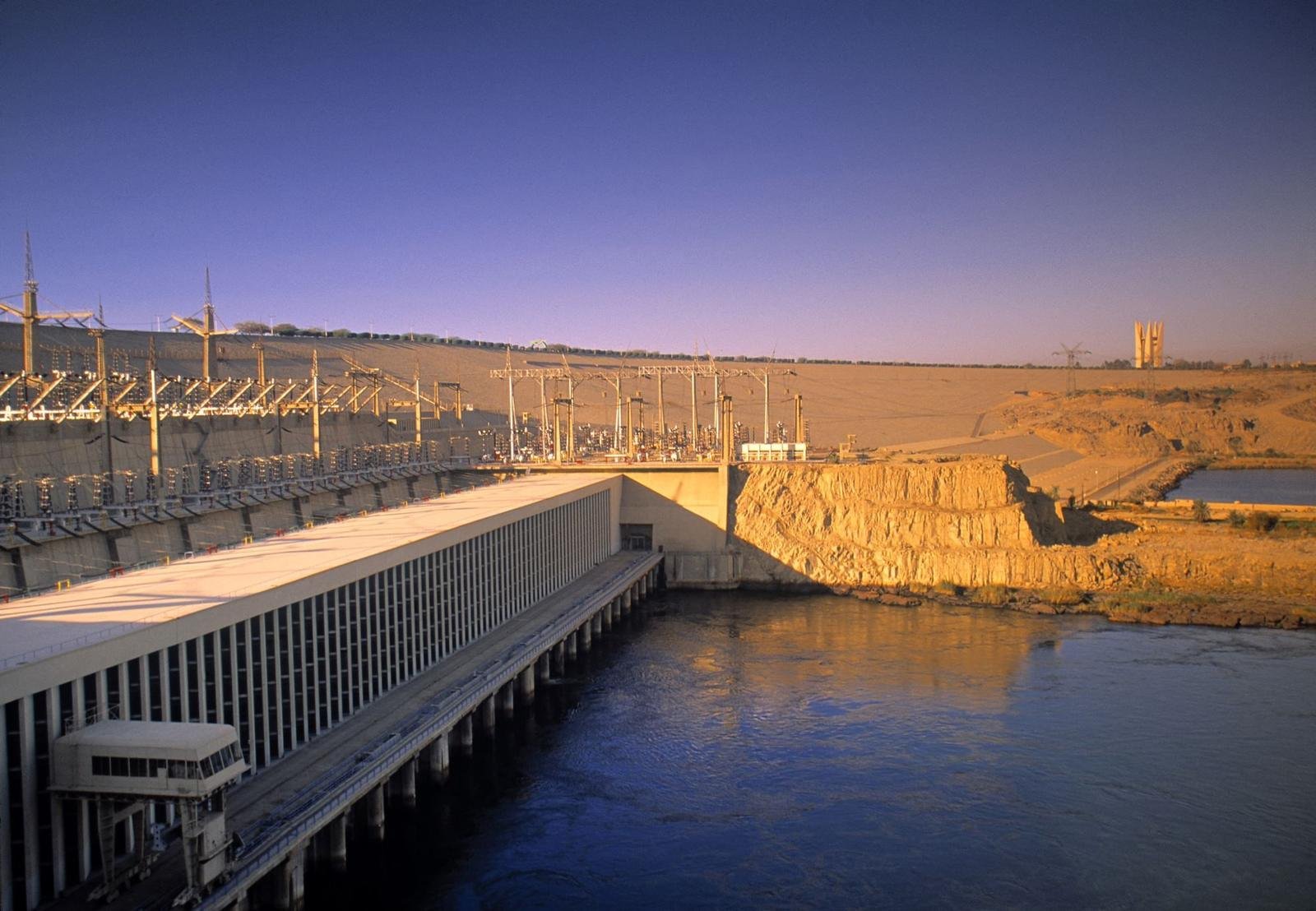
The Nile stretching beside the Aswan High Dam on a sunny day
Aswan High Dam Facts at a Glance
| Feature | Detail |
|---|---|
| Location | On the Nile, south of Aswan, Egypt |
| Type | Rock-fill embankment dam |
| Built | 9 January 1960 to July 1970; inaugurated January 1971 |
| Length | 3,830 m along the crest |
| Height | 111 m |
| Width | 980 m at the base, 40 m at the crest |
| Material | About 43 million cubic meters |
| Power station | 12 turbines of 175 MW each, 2,100 MW installed |
| Annual output | About 10 billion kWh (10,042 GWh in 2004) |
| Lake Nasser | About 5,250 km² surface area |
| Cost | About E£450 million |
| Workforce | About 25,000 Egyptian engineers and workers |
What Is Lake Nasser?
Lake Nasser is the reservoir behind the dam. The Egyptian part keeps the name Lake Nasser, while Sudan calls its smaller part Lake Nubia. The lake covers about 5,250 km² and reaches roughly 130 m at its deepest. Its length is usually given as roughly 500 km, though sources quote figures between about 480 and 550 km. Capacity figures also differ by source: about 132 billion cubic meters is widely quoted, and higher design figures of up to about 169 billion appear in other references. The reservoir first reached capacity in 1976.
The lake stores water; it does not create it. Operators hold water back in wet years and release it in dry ones, which moves water through time rather than adding to the Nile’s supply. Visitors who want to see the Nubian temples on its shores travel by Lake Nasser cruise.
What Were the Benefits and the Costs?
Benefits. The dam moderates floods, keeps a reserve for dry years, makes irrigation more reliable through the year and produces electricity. At its 1970 peak the station supplied about half of Egypt’s electricity. As national demand grew, that share fell to about 15% by 1998.
Costs. Before the dam, the Nile carried roughly 134 million tons of sediment a year. The reservoir now traps most of it, so downstream farmland no longer receives its yearly layer of natural fertilizer, and farmers rely more on artificial fertilizer. Less sediment also reaches the Delta coast. Fisheries changed as well. Mediterranean catches, historically 35,000-40,000 tons a year, fell to 20,000 tons or less by 1971, and the sardine catch dropped from 18,000 tons in 1962 to 460 tons in 1968. Lake Nasser developed its own fishery, which produced about 35,000 tons a year in the mid-1990s.
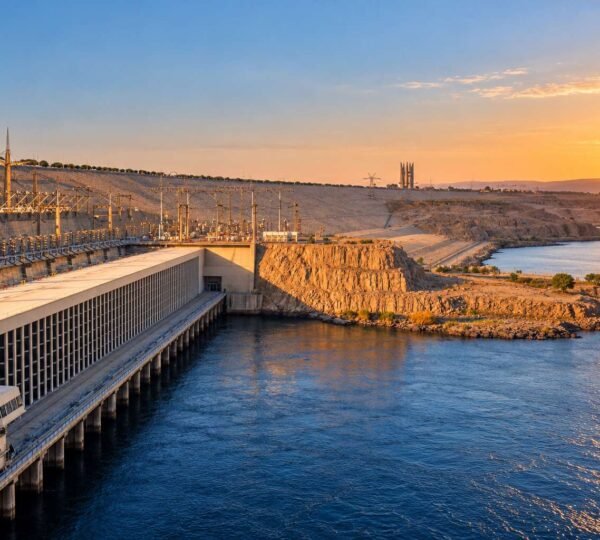
Sunset over the Aswan High Dam, one of Egypt’s greatest engineering landmarks
How Did the Dam Affect Nubian Communities?
Lake Nasser flooded the Nubian homeland. About 100,000 people in Egypt and Sudan were displaced, including about 50,000 in Egypt. Egyptian Nubians were resettled mainly in government-built villages around Kom Ombo, often called New Nubia. Families lost villages, farmland and places tied to their history. Any honest account of the dam’s achievement includes this human cost.
How Were the Nubian Temples Saved?
Rising water also threatened Nubia’s monuments. UNESCO launched its International Campaign to Save the Monuments of Nubia on 8 March 1960, and it ran until 1980. About 50 countries contributed to a total cost of roughly US$80 million, and 22 monuments and complexes were moved to higher ground.
The best known rescue is Abu Simbel. Its temples were cut into more than 1,000 blocks of about 30 tons each and rebuilt 64 m higher and 180 m further inland. The new site was inaugurated on 22 September 1968. Philae was moved to Agilkia Island between 1972 and 1979. Kalabsha, Beit el-Wali and the Kiosk of Qertassi were rebuilt at New Kalabsha near the High Dam, while Wadi es-Sebua, Dakka and Maharraqa were rebuilt at New Wadi es-Sebua. In 1979, UNESCO inscribed the Nubian Monuments from Abu Simbel to Philae on the World Heritage List.
Read our guides to the Temple of Philae, Kalabsha Temple, Wadi es-Sebua, Dakka and Maharraqa to see what each one offers.
What Can You See at the High Dam in Aswan?
The visitor area lies south of Aswan city. From the public viewing areas you can look along the dam toward Lake Nasser and take in the scale of the embankment. Visitors generally see the dam from the outside rather than from inside the power works. Expect security checks at the entrance, and confirm the current photography rules on arrival, because they can change. Opening hours and ticket prices also change from time to time.
The High Dam fits easily into a day with other Aswan sights. Our Private Aswan Highlights Tour combines it with Philae Temple and the Unfinished Obelisk, and our Aswan travel guide covers the rest of the city.
Practical Tips for Visiting
- Best season: October to April brings milder daytime weather, while summer heat in Aswan is intense.
- Go early: the light is better for photos and the day is cooler.
- Pack smart: sun hat, sunscreen, comfortable shoes and water.
- Leave extra time: allow for security checks and traffic between sites.
Visit the High Dam With Oceanus Tours & Travel
Oceanus Tours & Travel is a Luxor-based company that plans private trips across Egypt. On a private trip, we provide a private car and an Egyptologist guide who stays with you throughout the whole trip, so the dam, the temples and the history of Lake Nasser connect into one story. On a Nile cruise, a guide is with you throughout the trip too.
Planning to continue into Nubia? We also arrange a private Lake Nasser cruise visit to Wadi es-Sebua, Dakka, Maharraqa and Amada together. Browse our Aswan day tours, Nile cruises and travel packages, or contact us to plan a tailor-made trip:
- Call / WhatsApp: (+20) 101 806 4111
- Email: info@oceanusluxor.com
- Contact form: oceanusluxor.com/contact
Frequently Asked Questions
Who built the Aswan High Dam?
Egyptian engineers and workers built it with Soviet technical and financial help. Nikolai Malyshev of the Hydroproject Institute in Moscow designed it, and Arab Contractors led the Egyptian side.
When was the Aswan High Dam built?
Construction began on 9 January 1960, the dam was completed in July 1970, and it was inaugurated in January 1971.
What is the lake behind the Aswan High Dam called?
Lake Nasser in Egypt. The part in Sudan is called Lake Nubia.
What is the difference between the Old Aswan Dam and the High Dam?
The Old Aswan Dam was completed in 1902 and raised twice, and its storage was limited. The High Dam, built from 1960 to 1970 about 6 km upstream, stores far more water and generates electricity.
Why is the Aswan High Dam controversial?
It brought flood control, water storage and electricity, but it also displaced about 100,000 Nubians, put heritage sites at risk, and trapped sediment that once fertilized farmland and fed fisheries.
How can I visit the Aswan High Dam with a guide?
Oceanus provides a private car and an Egyptologist guide throughout your trip. Contact us to plan it.
Where is the Aswan High Dam located?
The Aswan High Dam is on the Nile in southern Egypt, just south of Aswan city, where the river flows into Lake Nasser.
Conclusion
The Aswan High Dam is more than a piece of engineering. It reshaped the Nile, powered a country, uprooted Nubian communities and sparked an international rescue of ancient temples. With an Egyptologist guide beside you, a short stop at the dam becomes a way to understand modern Egypt and Nubia together.
Sources and Further Reading
- UNESCO World Heritage Centre, Nubian Monuments from Abu Simbel to Philae
- UNESCO World Heritage Centre, Working Together: Abu Simbel
- Encyclopaedia Britannica, Nubian Valley
- Wikipedia, Aswan High Dam and Aswan Low Dam
- HISTORY, United States withdraws offer of aid for Aswan Dam