
The Abu Simbel temples are two rock-cut temples that Ramesses II carved into a sandstone cliff on the western shore of Lake Nasser, in Egypt’s far south. Four colossal statues of the king guard the entrance of the larger temple, and twice a year the dawn sun reaches deep into its sanctuary. This guide explains who built the temples, what you will see, how UNESCO moved them in the 1960s, and how to visit from Aswan with Oceanus Tours & Travel.
Where Are the Abu Simbel Temples?
Abu Simbel Temples lie in Nubia, about 280 kilometres south of Aswan and close to the Sudanese border. It is one of the best-known Lake Nasser temples, and unlike most of them it is easy to reach from Aswan by road or by a short flight.
When the temples were carved, the lake did not exist. Lake Nasser formed after the Aswan High Dam was completed, which is why the temples stand on higher ground today.
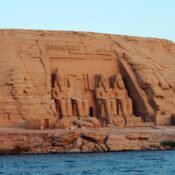
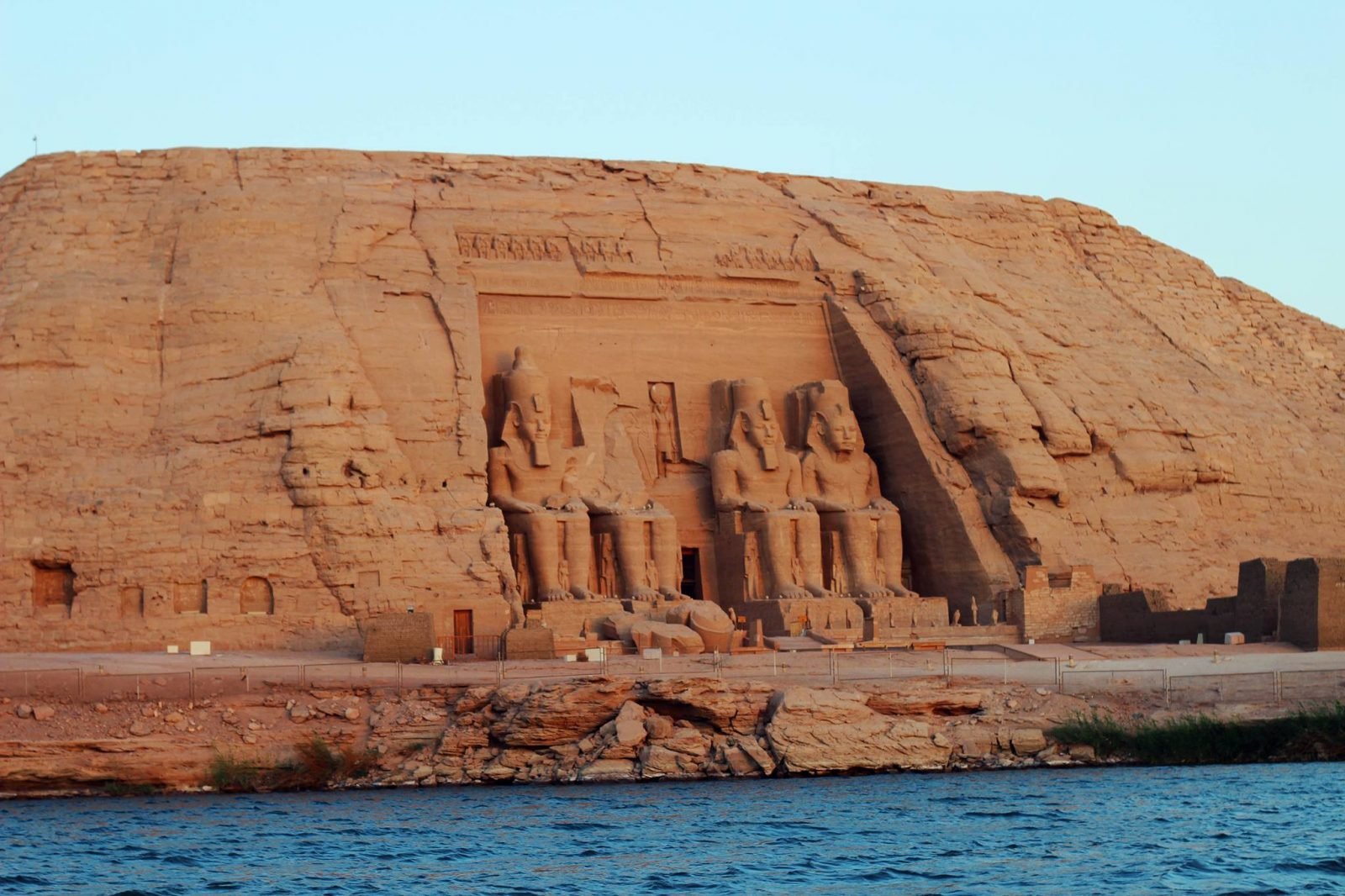
The entrance of the Great Temple, flanked by statues of Ramesses II
Who Built Abu Simbel and Why?
Ramesses II ordered the temples in the 13th century BCE, and construction took roughly twenty years. Their position on Egypt’s southern frontier made a clear statement of royal power to anyone travelling north from Nubia.
Over the centuries, drifting sand buried most of the facade. The Swiss traveller Johann Ludwig Burckhardt noticed the top of it in 1813, and the Italian explorer Giovanni Belzoni cleared the entrance and went inside in 1817.
The Great Temple of Ramesses II
Four seated statues of Ramesses II, each about 20 metres high, fill the facade. One of them collapsed in an ancient earthquake, and its upper body still lies at its feet.
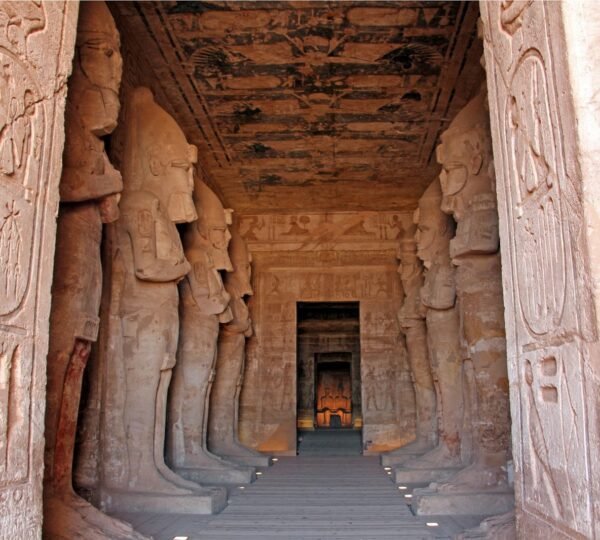
The temple runs about 63 metres into the rock. Statues of the king as Osiris line the first hall, and the path continues to the sanctuary, where four seated figures wait: Ramesses II, Amun-Re, Ra-Horakhty and Ptah. The temple was built to honour these gods together with the king himself.
The first hall is also a record of royal propaganda. Its walls carry large scenes of the Battle of Kadesh, in which Ramesses II fought the Hittites around 1274 BCE, and he presents the outcome as a personal triumph. Compare this with the quieter religious scenes closer to the sanctuary, where the king appears before the gods.
Look at the legs of the colossi, too. In the sixth century BCE, Greek and Carian soldiers serving the pharaoh Psamtik II scratched their names into the stone, and the inscriptions are still visible on one of the statues. They are valuable evidence for the history of Greek mercenaries in Egypt.
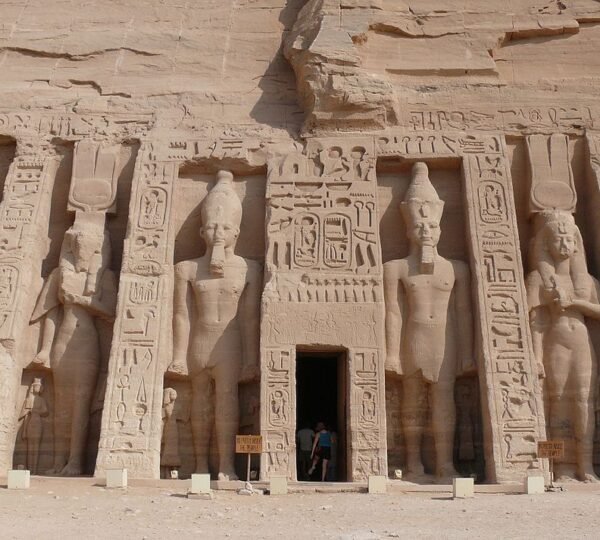
The Small Temple is dedicated to Queen Nefertari and the goddess Hathor
The Small Temple of Nefertari and Hathor
A short walk away, the smaller temple is dedicated to the goddess Hathor and to Queen Nefertari. Its facade carries six standing statues, about 10 metres tall, showing Ramesses II and Nefertari. It is unusual because the queen appears at almost the same height as the king, which was rare in Egyptian royal art.
Great Temple and Small Temple Compared
| Great Temple | Small Temple | |
|---|---|---|
| Dedicated to | Ramesses II, Amun-Re, Ra-Horakhty, Ptah | Hathor and Queen Nefertari |
| Facade | Four seated statues, about 20 m high | Six standing statues, about 10 m high |
| Depth | About 63 m into the rock | Much shorter, with a few chambers |
| Known for | The sun alignment | Nefertari shown at the king’s scale |
The Abu Simbel Sun Alignment
Twice a year, on 22 February and 22 October, the rising sun sends light along the whole length of the Great Temple. The beam reaches the sanctuary and lights the statues of Ramesses II, Amun-Re and Ra-Horakhty. Ptah, the god linked with darkness, stays in shadow. The effect lasts about twenty minutes.
The temples were moved in the 1960s, and Egyptian reports note that the alignment now falls one day later than it did at the original site. The original orientation was kept, but it was not possible to reproduce the exact date.
The alignment depends on a clear sky, and the site becomes very crowded on both dates. Special admission prices apply, and visitors queue in the dark before opening. If you only want to see the temples in comfort, a visit a day before or after is quieter.
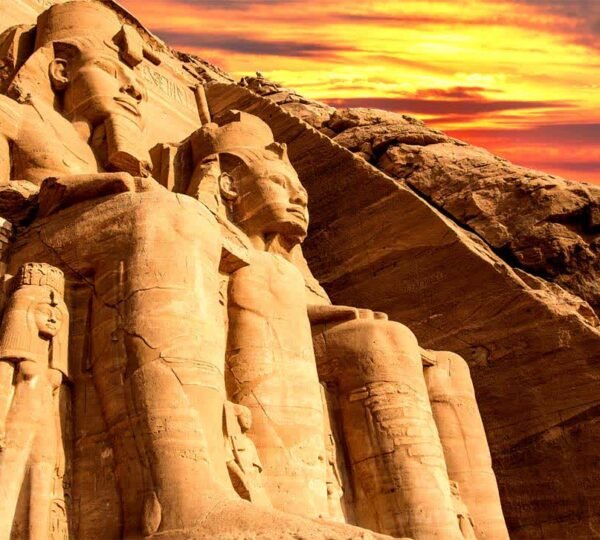
close look at one of the colossi guarding the Great Temple
How UNESCO Saved the Temples
By the late 1950s it was clear that the reservoir behind the Aswan High Dam would flood Abu Simbel. UNESCO launched an international campaign, and engineers from many countries took part in the rescue.
Between 1964 and 1968, workers cut both temples into more than 1,000 blocks, some weighing up to 30 tons. They rebuilt them about 65 metres higher and 200 metres further back from the river, inside an artificial hill that recreates the original cliff. The Nubian Monuments from Abu Simbel to Philae were added to the World Heritage List in 1979.
The same campaign moved Philae Temple to Agilkia Island, and it saved the temples described in our Lake Nasser temples guide.
How to Get to Abu Simbel from Aswan
By road, the trip covers about 280 kilometres and takes roughly three to four hours each way. Most day trips leave Aswan very early so that you arrive before the heat and the crowds. A flight from Aswan takes about 45 minutes, which makes a same-day visit much easier.
There is a third way to arrive. A dedicated Lake Nasser cruise sails from behind the High Dam and links Abu Simbel with the other Nubian temples along the shore, so you reach the site by water instead of spending hours on the desert road. Our Lake Nasser temples guide shows which sites the cruise covers.
A day trip is possible but long. If you want to avoid the rush, plan an overnight stay in Aswan and read our Aswan travel guide and our page on the Unfinished Obelisk for ideas on the rest of your stay.
Best Time to Visit Abu Simbel
The cooler months, from October to April, are the most comfortable time for the temples, because the site is open-air and has little shade. Summer temperatures in this part of southern Egypt are very high, so an early start matters even more. The sun alignment dates fall in February and October, which suit the cooler season well, but they bring the biggest crowds of the year.
Early morning light is also the best time for photographs, when the sun strikes the facade and the colossal faces are clearest.
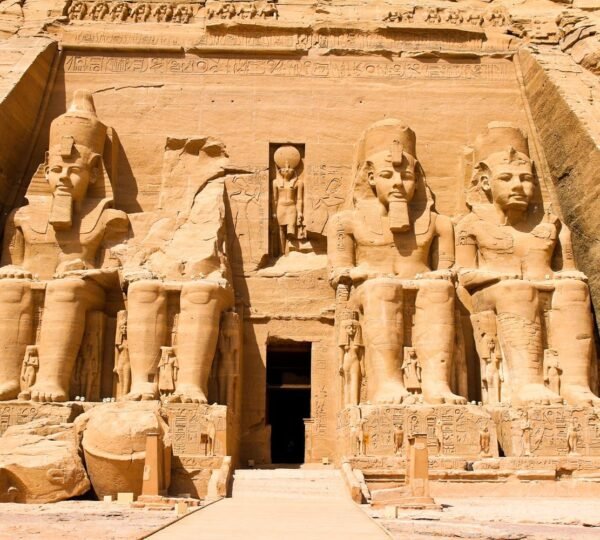
The four seated colossi of the Great Temple
Practical Tips for Visiting
- Allow two to three hours at the temples, not counting the transfer.
- Arrive early. Midday is hot, and tour groups cluster in the late morning.
- Check the official opening hours and ticket prices before you travel, because they change.
- Wear a hat and comfortable shoes, and bring water.
- Ask your guide about the photography rules inside the temples before you go in.
Visit Abu Simbel and Lake Nasser with Oceanus Tours & Travel
Oceanus Tours & Travel can arrange Abu Simbel temples as a private day trip from Aswan or as part of a full Lake Nasser program. We operate our own cruise, which sails from behind the High Dam, so you can see the temples along the lake with a company guide and no fixed group schedule.
These trips are tailor-made and arranged on request, so the route, the number of nights and the sites can be adjusted to your dates. Contact us to plan your visit, and ask what is included in your quote, such as transfers, tickets and guiding.
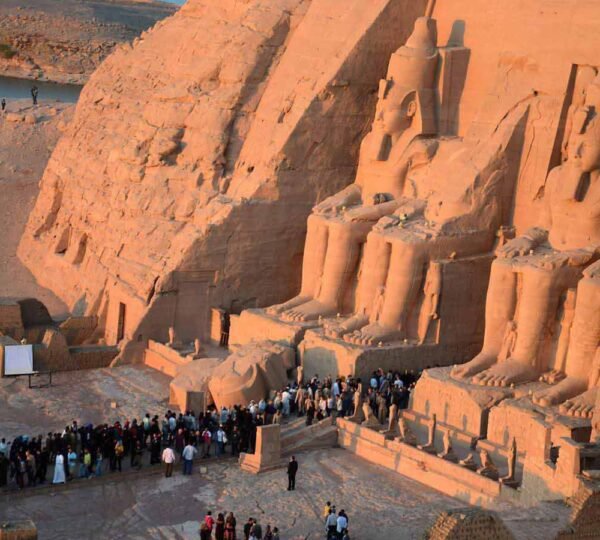
Abu Simbel can be visited from Aswan by road or by a short flight
Abu Simbel Temples FAQ
Where are the Abu Simbel temples?
They are in Nubia, in southern Egypt, on the western bank of Lake Nasser about 280 kilometres south of Aswan.
Is Abu Simbel closer to Aswan or Luxor?
It is much closer to Aswan. Most visitors travel from Aswan by road or by a short flight.
How long is the drive from Aswan to Abu Simbel?
The drive takes roughly three to four hours each way, and a flight takes about 45 minutes.
How much time do I need at Abu Simbel?
Allow two to three hours at the temples, plus the transfer time.
Is Abu Simbel worth visiting?
For most travellers, yes. It combines huge rock-cut statues, an unusual temple for a queen and a remarkable modern rescue story. The only real cost is the long transfer from Aswan.
When does the sun reach the sanctuary?
On 22 February and 22 October, at dawn. It depends on weather, and the next one is on 22 February 2027.
Who built Abu Simbel?
Ramesses II built both temples in the 13th century BCE. The smaller temple was dedicated to his wife, Queen Nefertari, and to the goddess Hathor.
Why were the Abu Simbel temples moved?
The reservoir behind the Aswan High Dam would have covered them. An international UNESCO campaign cut them into blocks and rebuilt them on higher ground between 1964 and 1968.
Can I do Abu Simbel as a day trip from Aswan?
Yes, by road or by flight, but the road trip makes for a long day. An overnight stay in Aswan is more comfortable.