
Most visitors to Egypt chase the giants: Karnak, the Valley of the Kings, Abu Simbel. But travelers who venture south of Aswan discover something quieter and, in its own way, more intriguing: a small Roman temple that was never finished, stands on a spot that once marked the southern border of an empire, and was lifted stone by stone to escape a rising lake. This is the Temple of Maharraqa, and it is one of Lower Nubia’s best-kept secrets.
In this guide, we cover what the temple is, why it matters, and how you can visit it with a private, expert-led trip from Oceanus Tours & Travel.
What Is the Temple of Maharraqa?
The Temple of Maharraqa is a Roman-era temple in Lower Nubia, dedicated to the deities Isis and Serapis. It dates to roughly the first century CE, built after Rome annexed Egypt in 30 BCE. Scholars cannot pin it to a specific emperor, because the temple was never completed and was never inscribed. Since temple building in Nubia declined after the reign of Augustus, many researchers think it may belong to his time.
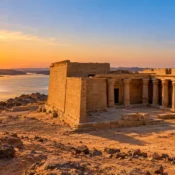
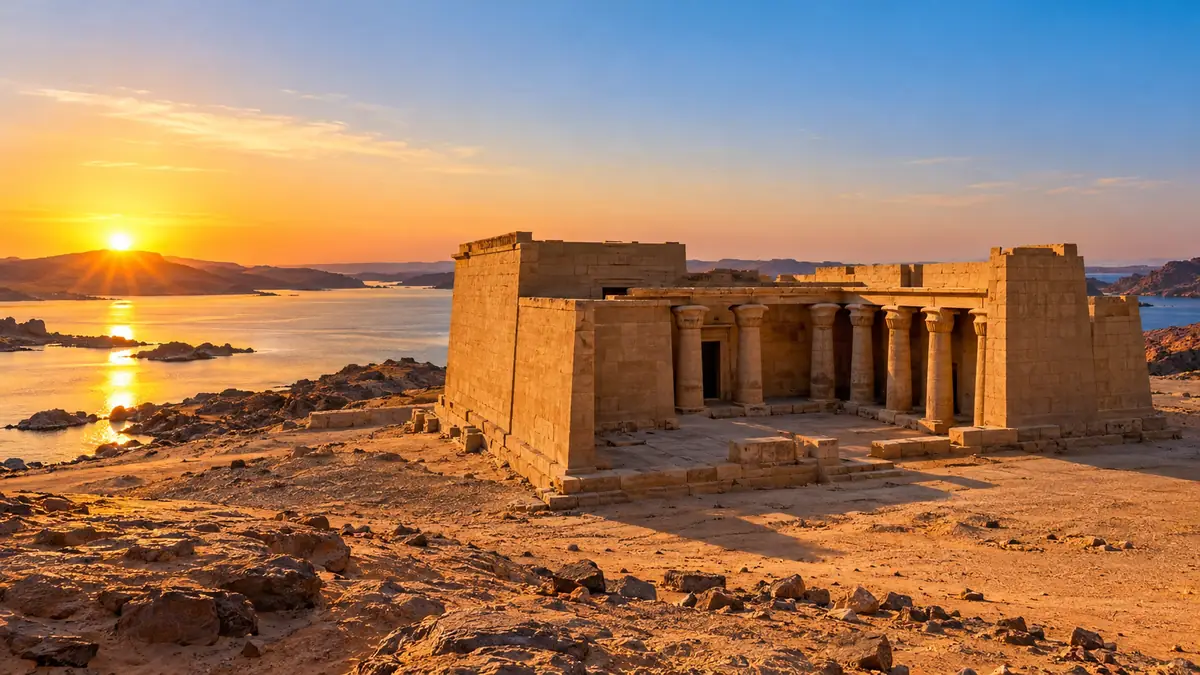
The temple is the smallest of the three monuments at the site of Wadi es-Sebua, and the only part that was actually finished is an inner court surrounded by columns on three sides. That unfinished quality is exactly what makes it so interesting. You are looking at a building frozen mid-project, a snapshot of Roman ambition meeting the limits of a remote frontier.
A Temple at the Edge of the Roman Empire
To understand why a Roman temple stands this deep in Nubia, you have to look at the politics of the time. After Egypt became a Roman province, the kingdom of Meroë (the Kushite state to the south) launched raids into Roman territory. The Roman prefect of Egypt, Gaius Petronius, retaliated and defeated the Meroitic army. He then garrisoned 400 troops at the southern outpost of Qasr Ibrim. After negotiations, a permanent frontier was established at Maharraqa.
That made Maharraqa the extreme southern boundary of Roman Egypt. Today the temple sits roughly 140 km (about 87 miles) south of Aswan, and standing in its courtyard you are standing, symbolically, at the edge of the Roman world.
Isis and Serapis: Two Traditions, One Sanctuary
The choice of gods tells its own story. Isis was one of Egypt’s most beloved deities, and her worship had deep roots in Nubia long before Rome arrived. Serapis, by contrast, was a god of the Greco-Roman era, a blend of Egyptian and Hellenistic ideas that Rome embraced as a unifying religious symbol.
Pairing the two at Maharraqa reflected Rome’s pragmatic approach to ruling Egypt: respect the traditions people already honored, while weaving in imperial religious culture. For history lovers, it is a rare chance to see this cultural blending written in stone.
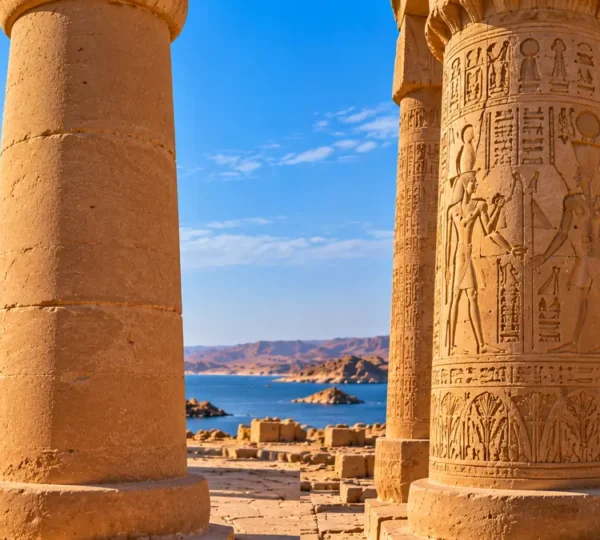
What You’ll See at the Temple
Because the building was left incomplete, Maharraqa feels different from the monumental temples you may have already seen in Luxor or Aswan. Expect:
- A columned inner court, the one completed element, surrounded by columns on three sides.
- Smooth, uninscribed surfaces, a reminder that the decoration phase never happened.
- A peaceful, uncrowded setting, since it lies far from the main tourist circuits.
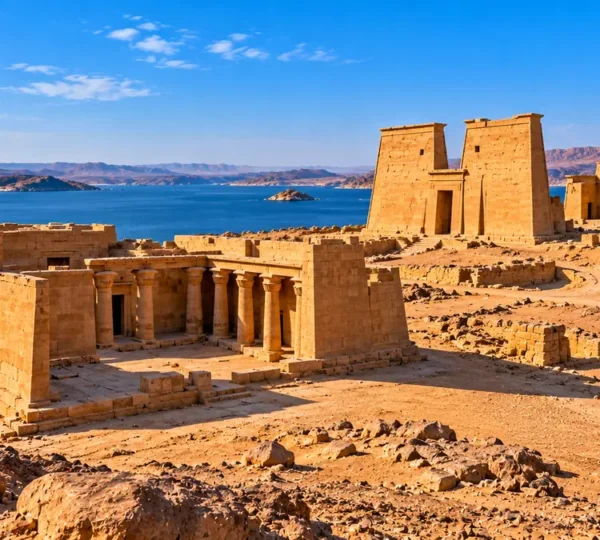
- Open desert and lake views, with the temple complex sitting on the banks of Lake Nasser.
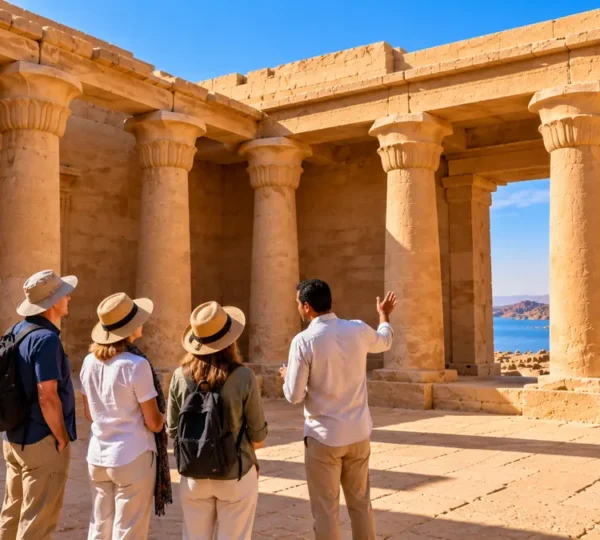
Your Oceanus guide will walk you through the architecture, explain the Roman-Nubian history, and point out details most visitors walk right past.
Saved From the Water: The UNESCO Rescue
The Temple of Maharraqa did not always stand where it does today. It originally stood near the ancient site of Ofendina, about 40 km north of Wadi es-Sebua. When construction of the Aswan High Dam threatened to flood the Nubian Nile Valley and create Lake Nasser, an international effort began: the UNESCO-led International Campaign to Save the Monuments of Nubia.
The temple was dismantled and rebuilt between 1961 and 1966 at its present home, New Wadi es-Sebua, about 4 km (2.5 miles) west of the original Wadi es-Sebua site. The Egyptian Antiquities Service dismantled the neighboring Wadi es-Sebua temple in 1964, with support from the United States. Maharraqa and the Temple of Dakka were moved and rebuilt there as well.
It is one of history’s great cooperative preservation projects, and you can walk through the result today. Another Nubian temple saved in the same campaign is Kalabsha Temple, rebuilt stone by stone near Aswan.
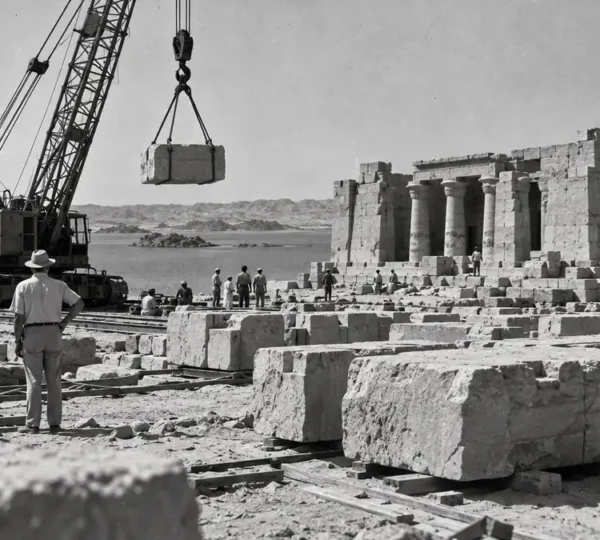
Dismantling Nubian temples in the 1960s UNESCO campaign (illustration)
Where to Find It: New Wadi es-Sebua
Maharraqa is one of three temples at New Wadi es-Sebua, so one visit rewards you with three very different monuments:
- The Temple of Wadi es-Sebua. Built under Ramesses II (reigned 1279-1213 BCE) and dedicated to Amun-Ra, Ra-Harakhty and the deified pharaoh himself. Its name means “Valley of the Lions,” inspired by the sphinxes that lined its entrance. Amenhotep III also built a temple at the original site.
- The Temple of Dakka. A Greco-Roman temple dedicated to Thoth, known for its 12-meter-high pylon. Read our full Temple of Dakka guide for its history and visiting tips.
- The Temple of Maharraqa. The small, unfinished Roman sanctuary at the heart of this article.
Visiting all three gives you a compact tour through more than a thousand years of Nubian history, from the New Kingdom pharaohs to Roman rule.
Practical Tips for Travelers
- Best season: October through April brings milder temperatures. Summer heat in Lower Nubia is intense.
- Go early: Morning light is better for photos and the desert is cooler.
- Pack smart: Sun hat, sunscreen, sturdy walking shoes, and plenty of water.
- Bring cash: Small bills for tips and small purchases are always handy.
- Dress respectfully: Light, breathable clothing that covers shoulders and knees works well.
- Plan the logistics: This is a remote area, so reliable transport and an experienced guide make a real difference.
Visit Maharraqa With Oceanus Tours & Travel
Based in Luxor, Oceanus Tours & Travel specializes in private, well-organized journeys across Egypt, including Aswan and Lower Nubia. Remote sites like Maharraqa are exactly where having the right team matters most.
Your tour guide stays with you every step of the way. From the moment we pick you up to the moment we drop you back at your hotel, your guide is with you at every site, explaining the history, answering your questions, and handling the details so you can simply enjoy the experience.
Comfortable private transportation, matched to your group. Whether you are a couple, a family, or a larger group, we arrange the vehicle that suits you: a private car, a van, or a coaster minibus. You travel at your own pace, in air-conditioned comfort.
Easy to book. Browse our Aswan day tours, open the tour that fits your plans, and book directly on its page. Prefer to talk it through first? Message us and we will help you build the right itinerary around your interests and schedule.
Want to pair Maharraqa with other Aswan highlights? Take a look at our Private Aswan Highlights Tour (High Dam, Philae Temple and the Unfinished Obelisk), our Private Guided Tour of Kalabsha Temple and the Nubian Museum, or read our Philae Temple travel guide.
Plan Your Trip
Ready to see the temple most travelers never hear about? Contact our team:
- Call / WhatsApp: (+20) 101 806 4111
- Email: info@oceanusluxor.com
- Contact form: oceanusluxor.com/contact

Frequently Asked Questions
Where is the Temple of Maharraqa located?
It is at New Wadi es-Sebua in Lower Nubia, on the banks of Lake Nasser, roughly 140 km (87 miles) south of Aswan.
Who built the Temple of Maharraqa?
It was built during the Roman period, likely in the first century CE, but it cannot be securely tied to any one emperor because it was never finished or inscribed.
Which gods was it dedicated to?
Isis and Serapis.
Why was the temple moved?
The Aswan High Dam and the creation of Lake Nasser threatened to submerge it, so it was relocated during the UNESCO-led Nubian salvage campaign.
Is the Temple of Dakka close to Maharraqa?
Yes. Both temples, along with the Temple of Wadi es-Sebua, stand together at New Wadi es-Sebua, so you can visit all three in one stop. See our Temple of Dakka guide for more.
Can I visit Maharraqa with a private guide?
Yes. Oceanus arranges private tours with a dedicated guide and a private car, van, or coaster, matched to your group. Contact us to plan it.
Conclusion
The Temple of Maharraqa may be small and unfinished, but it carries a big story: Roman power at its southern limit, a blend of Egyptian and Hellenistic faith, and a 20th-century rescue that saved a piece of Nubia from the water. With Oceanus and your private guide beside you, it is an unforgettable addition to any Egypt itinerary.