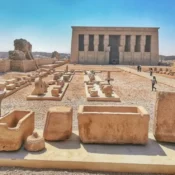

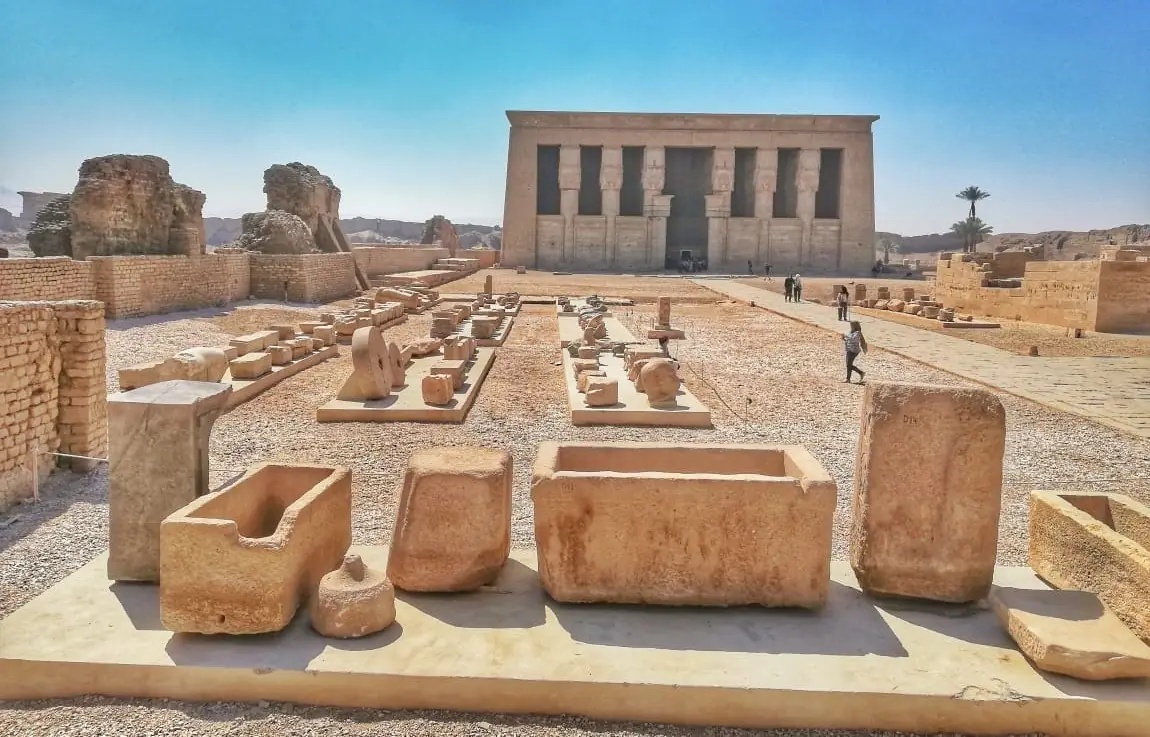
Dendera Temple is the temple of the goddess Hathor at Dendera in Qena, north of Luxor, and one of the best-preserved temple complexes in ancient Egypt. It is known for its Hathor-headed columns, its ceiling of astronomical engravings and its hidden crypts. It also makes an easy day trip from Luxor. This guide separates what research has established from the popular myths, and then covers the practical details of a visit.
Dendera Temple at a Glance
| Topic | What the sources say |
|---|---|
| Location | Qena, north of Luxor |
| Dedicated to | Hathor, whose main cult center was at Dendera |
| Present temple | Begun in 54 BC under Ptolemy XII, with Roman additions |
| Opening hours | 7:00 a.m. to 5:00 p.m., according to the Ministry |
| Extra ticket lines | “Temple panorama” and “Temple serdab” |
Hours and tickets come from the Ministry of Tourism and Antiquities page for Dendera, so check it again before you travel.
Why Was Dendera Important?
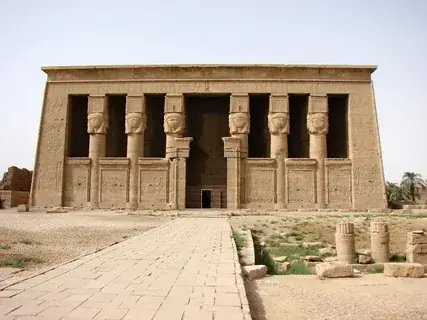
Hathor was an important goddess of ancient Egypt, linked with music and joy, and Dendera was her main cult center. The Ministry notes that evidence points to older structures on the site, going back to King Pepy I of the Old Kingdom. So the temple you see today is the latest stage of a long tradition, not a single moment in time.
How the Temple Grew
- Old Kingdom: evidence of older structures reaches back to Pepy I.
- 360–343 BC: Nectanebo II built the mammisi, a birth house, which is the earliest surviving building in the compound.
- 54 BC: construction of the existing Hathor temple began under Ptolemy XII, in the late Ptolemaic period.
- Roman period: Tiberius built the hypostyle hall, and a separate Roman mammisi dates to Trajan and Marcus Aurelius.
This is why the temple is Ptolemaic and Roman in date, even though it follows Egyptian tradition in style.
A Walk Through Dendera Temple
- The facade. The entrance has six massive columns topped with the head of Hathor, which the Ministry counts among Egypt’s most beautiful monuments.
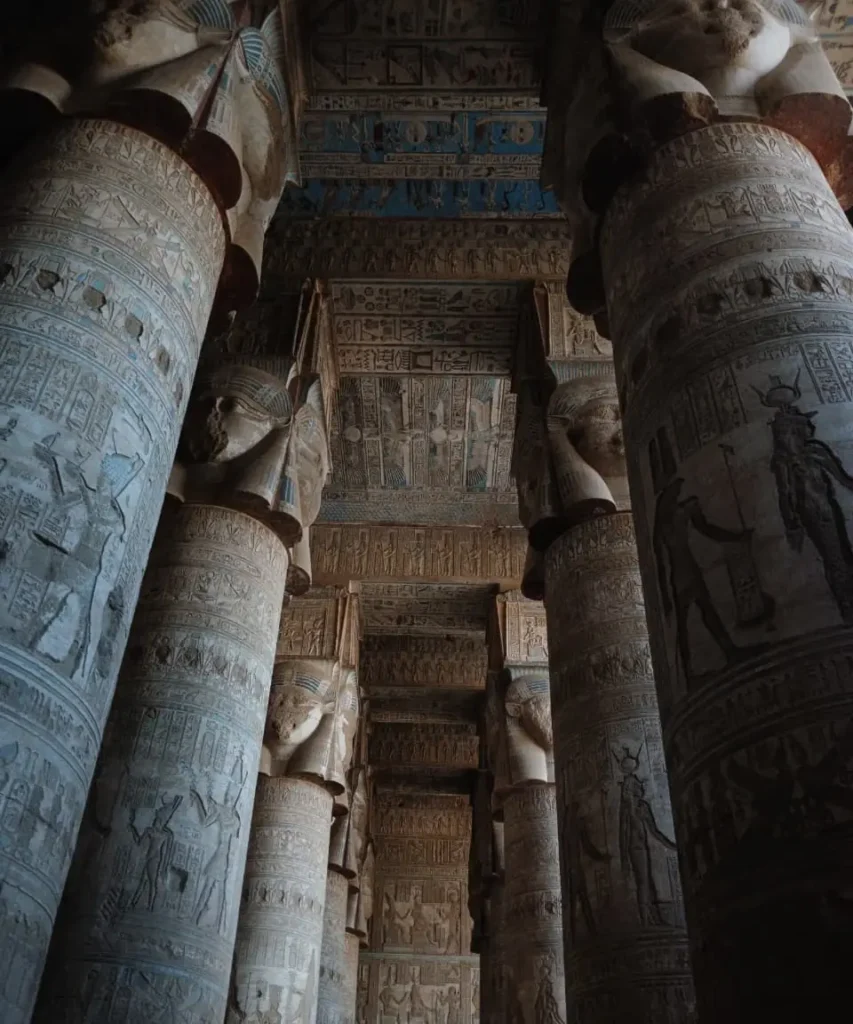
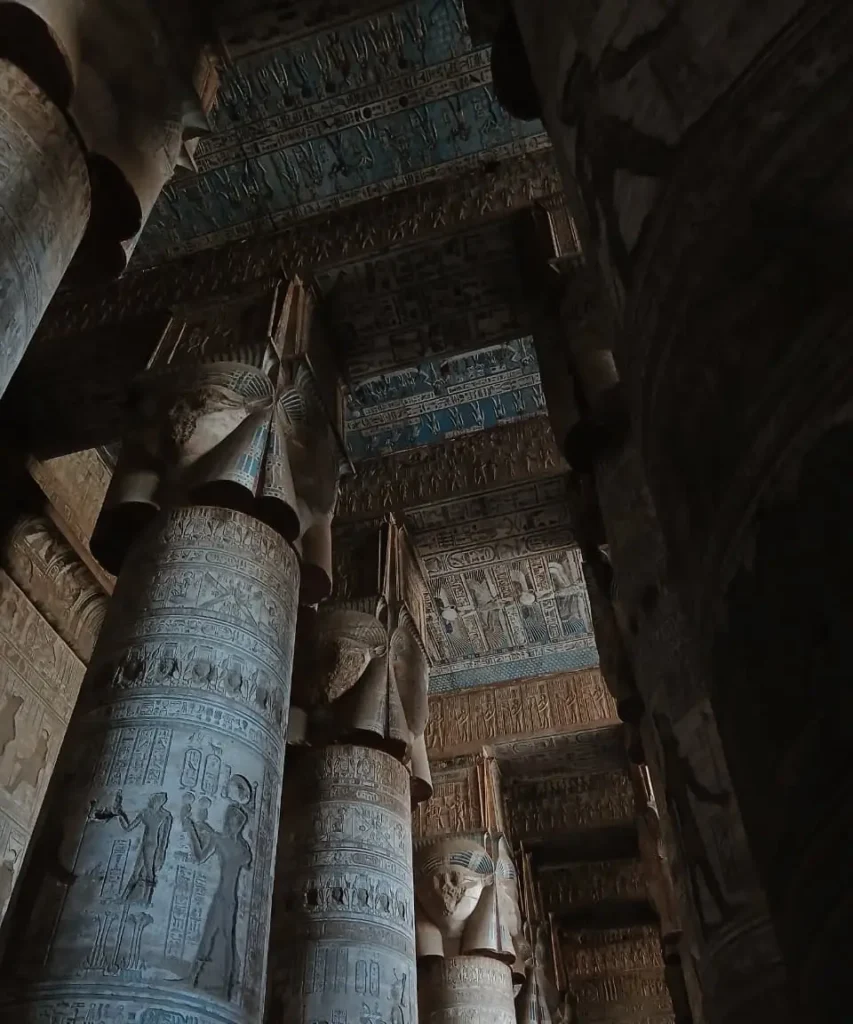
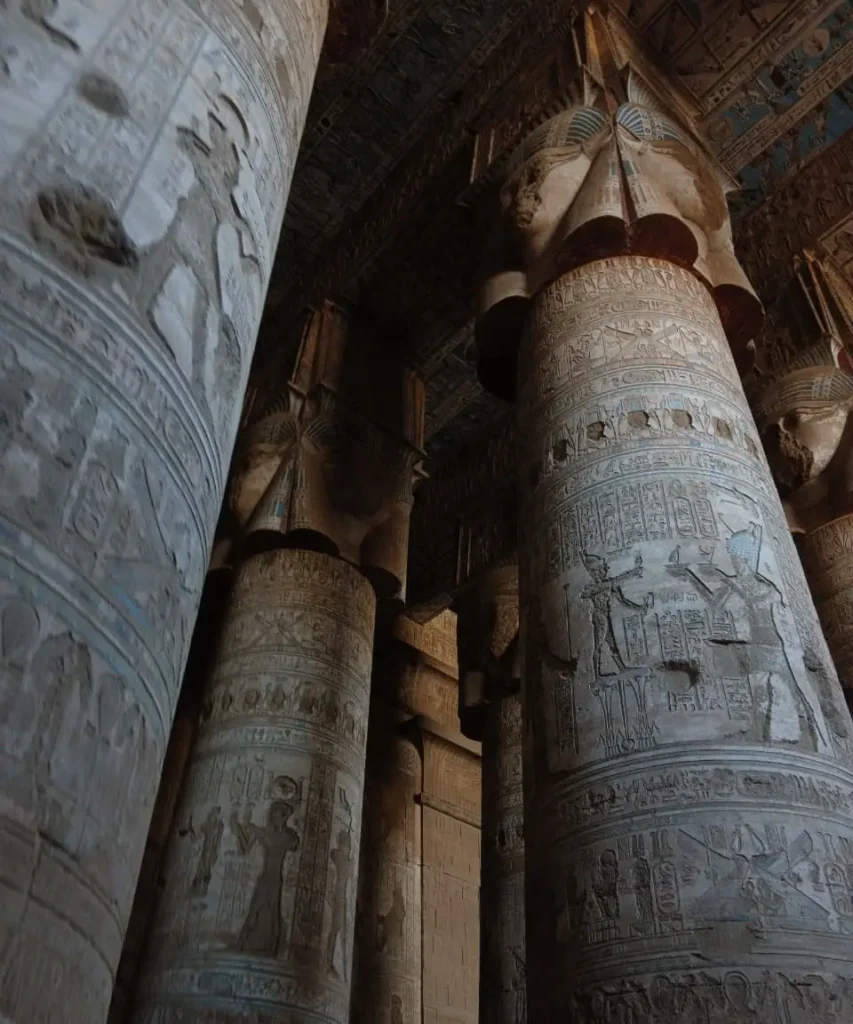
- The outer hall. Its column capitals resemble a sistrum, Hathor’s sacred rattle, with the goddess’s face carved on them.
- The ceiling. It carries a star chart showing the goddess Nut and elements of the zodiac, and the Ministry lists its astronomical engravings among the temple’s most notable features.
- The crypts. Narrow chambers are built into the walls over several levels, and some are decorated. Sources give different counts, from twelve to fourteen.
- The roof. Two chapels on the east and west sides were dedicated to the death and resurrection of Osiris. Staircases lead up to the roof.
- The rear wall. Outside, a carving shows Cleopatra VII with her son Caesarion.
The Dendera Zodiac
The Dendera Zodiac was a relief on the ceiling of one of the Osiris chapels on the roof. Egyptologists now date it to the first century BC. It was removed in 1820 and replaced with a copy, and the original is now in the Louvre. Wikipedia notes that it is disputed whether permission for the removal was granted, so do not expect to see the original on site.
Myth vs Fact
| Popular claim | What the evidence says |
|---|---|
| The “Dendera light” shows ancient light bulbs. | The reliefs show the god Harsomtus inside an oval container, which might represent the womb of the sky goddess Nut. The light-bulb reading comes from 20th-century pseudoarchaeology. |
| Dendera dates to the age of the pyramids. | The present temple dates to the late Ptolemaic and Roman periods, though older structures stood here. |
| The zodiac is still on the ceiling. | The original is in the Louvre, and a copy replaced it. |
For more detail, see the Wikipedia article on the Dendera Temple complex.
Restoration and What You Can See Now
A Ministry release says that restoration cleaned soot from the sandstone and fixed the colors, so inscriptions show more clearly. It reports that the first phase opened three basements and the roof, described as a “panorama,” while 11 other basements stayed closed. The second phase covered the Great Pillars Hall and the Al-Ishraq Hall, as well as the lighting. Which areas are open can change, so ask your guide before you go. You can read the Ministry news release for details.
How to Visit Dendera Temple From Luxor
The temple is open daily from 7:00 a.m. to 5:00 p.m. The Ministry lists separate ticket lines for the temple panorama and the temple serdab, so ask which areas need an extra ticket if you want to see everything. Start early to enjoy the temple in cooler weather, and wear light clothing, a hat and comfortable shoes.
Our full-day Luxor excursion to the temples of Dendera and Abydos includes Dendera. If you want a wider choice, browse our Luxor day tours and ask our team which one fits your plan. A licensed Egyptologist helps you read the reliefs and the astronomical ceiling.
Combine Dendera With Other Sites
Dendera pairs well with Luxor’s own sights. Try our East and West Bank full-day tour, our Luxor East Bank highlights tour or our Luxor and Mummification museums tour. Early risers can add a Luxor hot air balloon ride.
Heading south afterwards? Read our guides to Edfu Temple and Kom Ombo Temple. For a longer journey, see our Nile cruises, dahabiya cruises or Egypt travel packages, and read our Luxor travel tips.
Conclusion
Dendera Temple rewards a visit planned around its columns, its ceiling and its crypts. Confirm hours and open areas before you go. To plan your day, contact Oceanus Tours & Travel.
FAQ
Where is Dendera Temple?
It is in Qena, north of Luxor.
Which god is Dendera Temple dedicated to?
The main temple is dedicated to the goddess Hathor.
Is the Dendera light bulb real?
No. The reliefs show the god Harsomtus in a container that might represent the womb of Nut, and the light-bulb reading comes from pseudoarchaeology.
Where can I check the Dendera entry fee?
Fees change, so check the Ministry Dendera Temple page. On a private tour with us, confirm in advance whether admission is included.