
The Unfinished Obelisk in Aswan is a rare exception among ancient monuments: a granite obelisk still lying in the quarry where it was cut. It lies in the northern granite quarries of Aswan in southern Egypt, near the Nile. Workers cut it from the bedrock, but they never freed it from the rock beneath.
This guide explains how the stone was cut, why work stopped and what a visit involves today.
Quick Facts
- Location: Northern granite quarries, Aswan
- Estimated length: about 42 meters
- Estimated weight: about 1,090 metric tonnes (1,200 US tons)
- Attributed to: Queen Hatshepsut (debated; Thutmose III is another possibility)
- Status: Still attached to the bedrock, abandoned after a crack appeared
Key Takeaways
- The stone lies in the northern granite quarries of Aswan, Egypt
- Workers cut it from bedrock but never freed it
- A crack in the granite ended the project
- Visitors can see the trench walls and the tool marks
- With Oceanus Tours & Travel, a guide and a car stay with you for the whole trip
What Is an Obelisk, and Why Did Egyptians Build Them?
An obelisk was a tall, four-sided stone monument tied to the sun god Ra and placed at temple entrances, often in pairs. Each one was cut from a single piece of stone and tapered toward the top, which ended in a small pyramid-shaped tip called a pyramidion. The Egyptians called them tekhenu, and many carried inscriptions naming the king who ordered them.
The Unfinished Obelisk is believed to have been intended for the Karnak Temple complex in Luxor, possibly as a companion to the Lateran Obelisk, which originally stood at Karnak.
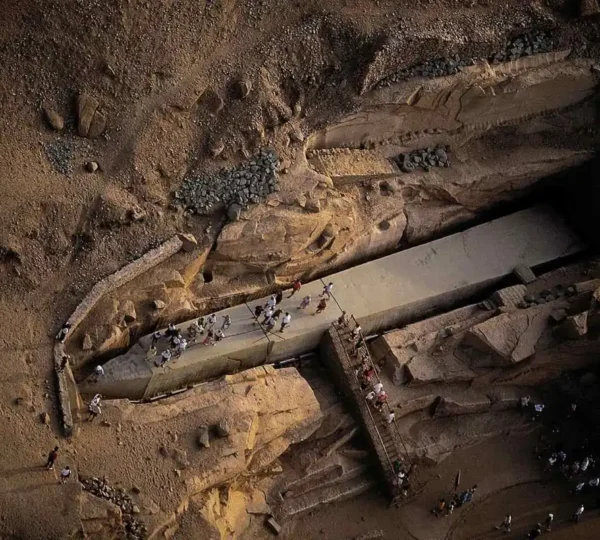
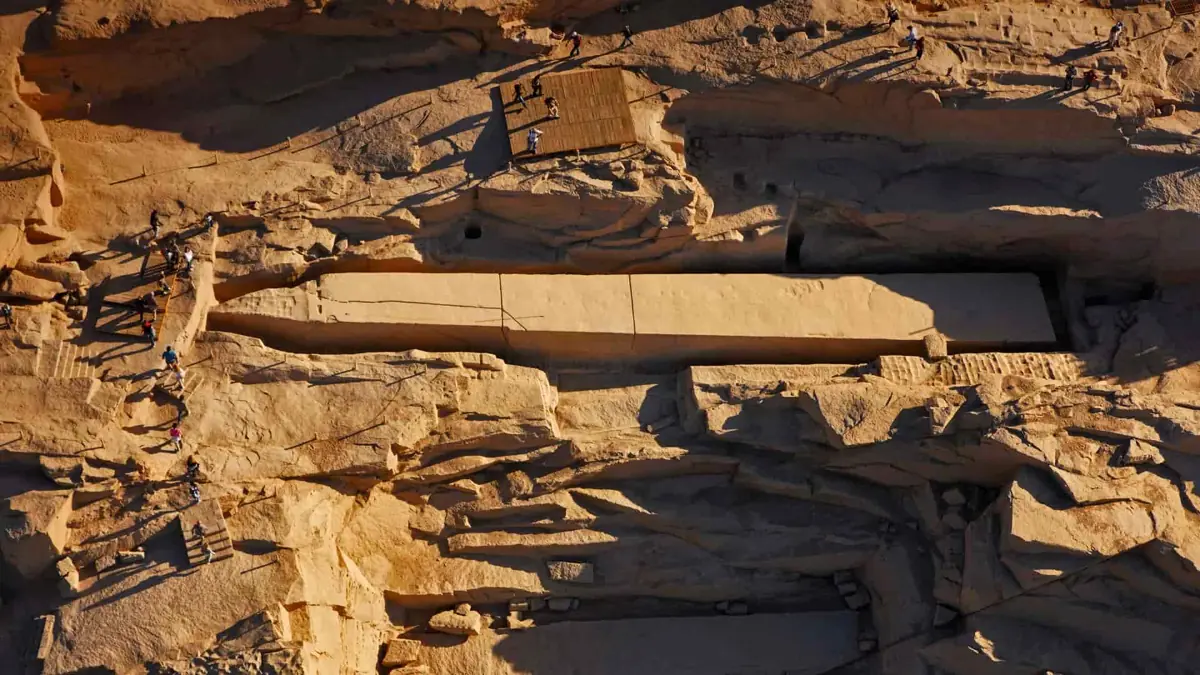
Visitors at the Unfinished Obelisk quarry in Aswan.
Why Aswan Granite Was Used?
Aswan was the main source of red granite in ancient Egypt. The stone is very hard and durable, which lets a tall, narrow monument stand for thousands of years. The quarries were used again and again across many centuries.
How Ancient Workers Cut Obelisks From Granite?
Workers pounded the granite with dolerite balls, round stones of a dark volcanic rock that is harder than granite. Each blow removed only a tiny piece, so cutting the deep trenches around the block took many months. Some of these dolerite balls are still scattered around the quarry.
Workers marked the outline with ochre-colored lines, and some of these guide lines are still visible on the stone. Some researchers believe they also used wooden wedges soaked with water to split the rock, though this method is debated for granite.
Metal was not the main tool. Copper is softer than granite, so it was used with quartz sand as an abrasive for finishing, not for breaking the rock.
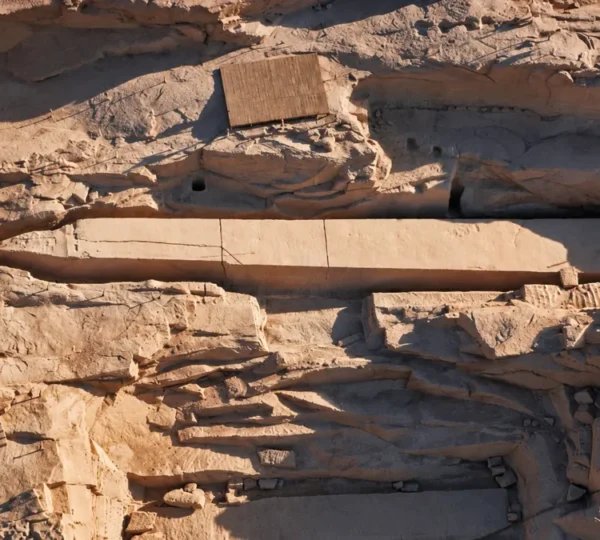
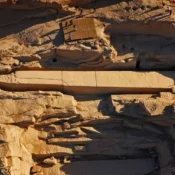
image of the Unfinished Obelisk in Aswan.
Why Work Stopped?
A crack appeared in the granite while the obelisk was being freed from the bedrock, and the project was abandoned. A flawed block could not be repaired once it was freed, so the builders left it in place. The decision suggests they preferred to abandon a flawed block rather than risk losing a monument after all the work of moving it.
The records that survive do not settle every question, including exactly when work stopped. What is clear is that the stone was never freed.
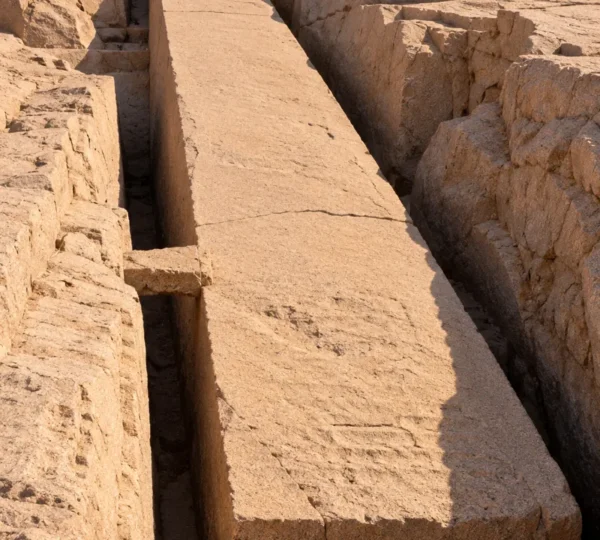
view along the length of the obelisk and its trench.
How Big Is the Unfinished Obelisk?
It is estimated at about 42 meters long and about 1,090 metric tonnes (1,200 US tons). That would make it nearly one-third larger than any ancient Egyptian obelisk ever erected. For comparison, the standing obelisks of Queen Hatshepsut at Karnak are roughly 30 meters high and weigh around 320 tons each.
Both figures are estimates. Nobody weighed the stone in antiquity, and the weight comes from its length, its taper and the known density of granite.
Who Commissioned the Unfinished Obelisk?
Queen Hatshepsut, who ruled during the early 18th Dynasty, is the figure most often linked to the project. Some scholars believe it was meant to mark the 16th year of her reign. Others suggest Thutmose III may have commissioned it instead. Scholars still debate both the patron and the exact date.
What Visitors See at the Quarry?
The site is open-air, and the quarry is officially protected as an archaeological site and open-air museum. Looking down at the trench, you see straight walls cut into the granite and circular pounding marks where dolerite stones struck the rock. Ochre-colored lines mark where the workers were cutting, and a partly worked obelisk base discovered in 2005 lies nearby.
Early morning is the most comfortable time to visit. Midday temperatures in summer often exceed 40 degrees Celsius, and the quarry offers little shade. Bring water, sun protection and closed shoes, since the ground is uneven.
Combining the Quarry With Other Sites in Aswan
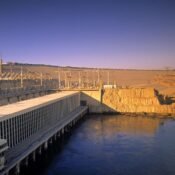
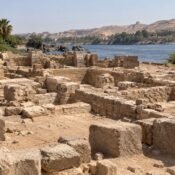
The quarry is often paired with Philae Temple, the Aswan High Dam and the Nubian Museum. Philae Temple, dedicated to the goddess Isis, was relocated to protect it from the waters of Lake Nasser. The High Dam explains why the river looks so different today, and the Nubian Museum shows the culture of the region.
With Oceanus Tours & Travel, a guide and a car stay with you for the whole trip, so you can move between the sites without arranging transport.
image of the Unfinished Obelisk in Aswan.
Why an Unfinished Monument Still Matters?
Many ancient obelisks now stand in Rome, Paris, London and New York after being moved from Egypt. The Unfinished Obelisk still lies in its original bed of rock. Visitors can stand where the workers stood and see a plan frozen mid-process, with each tool mark recording a choice made by a worker.
FAQ
How much does the Unfinished Obelisk weigh?
It is estimated at about 1,090 metric tonnes (1,200 US tons). This is an estimate, since the stone was never freed, and it is based on the obelisk’s length of about 42 meters and its tapering shape.
What is the largest obelisk in ancient Egypt?
The Unfinished Obelisk is the largest known ancient obelisk, nearly one-third larger than any ancient Egyptian obelisk ever erected. Because it was never raised, this is a comparison of planned size.
Why was the Unfinished Obelisk abandoned?
A crack appeared in the granite while the obelisk was being freed from the bedrock, and the project was abandoned. The stone is still attached to the bedrock today.
Who ordered the Unfinished Obelisk?
Queen Hatshepsut is the most common attribution. Thutmose III is another possibility, and some believe it was meant to mark the 16th year of her reign. Scholars still debate the patron and the date.
How long does a visit take?
Allow about an hour at the quarry. With Oceanus Tours & Travel, a guide and a car stay with you for the whole trip, so the visit can be combined with Philae Temple and the High Dam.
Visit the Unfinished Obelisk with Oceanus Tours & Travel
Oceanus Tours & Travel provides a guide and a car that stay with you for the whole trip. Our guide explains the quarry, the tool marks and the story of the crack as you visit, and the same trip can include Philae Temple and the High Dam.
Explore our Aswan tours or contact us to plan your trip.
Phone: (+20) 101 806 4111
Email: info@oceanusluxor.com
Website: oceanusluxor.com