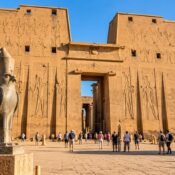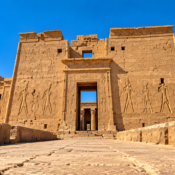

Kom Ombo Temple is one of the most unusual temples in Egypt: a double temple on the banks of the Nile, dedicated to two gods at once. This guide covers its history, what to see, how long to spend there, the best time to visit (September to May) and how to get there from Aswan, Luxor or your Nile cruise.
At Oceanus Tours, a Luxor-based Egyptian travel company with more than 25 years of experience, we have welcomed over 46,000 happy travelers, and our newer team members are just as experienced and passionate about Egypt. We have put everything we know about Kom Ombo into this one article.
What Is Kom Ombo Temple?
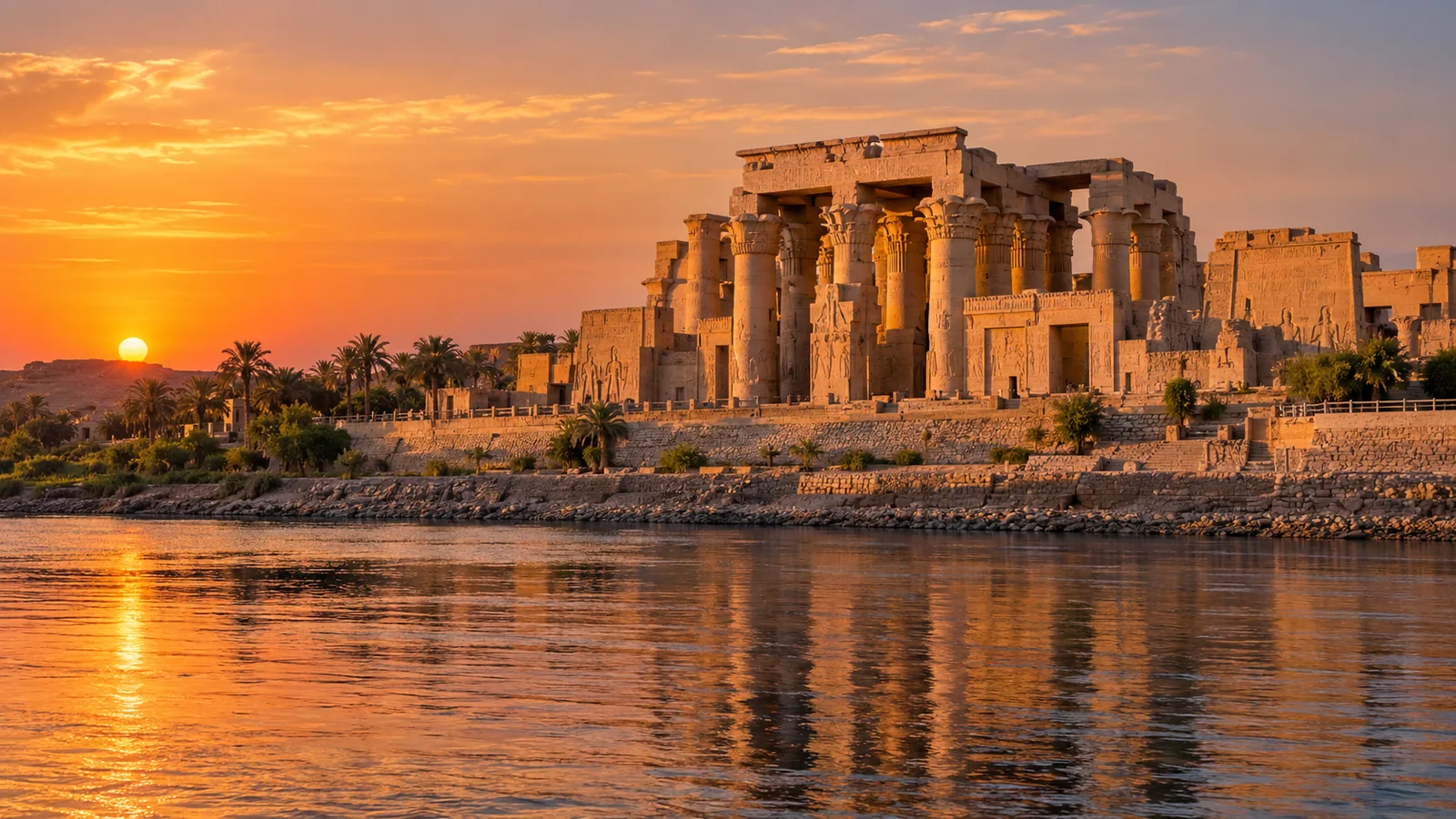
Kom Ombo Temple stands on a raised mound beside the Nile, about 40 km north of Aswan. The name comes from the Arabic word kom, meaning mound. The temple was built mostly in the Ptolemaic period, and Roman emperors added to it later.
What makes it special is the layout. Kom Ombo is a double temple, with two of almost everything: two entrances, two halls and two sanctuaries, arranged symmetrically along one central axis. One half honors Sobek, the crocodile god, and the other honors Haroeris, a form of Horus the Elder.
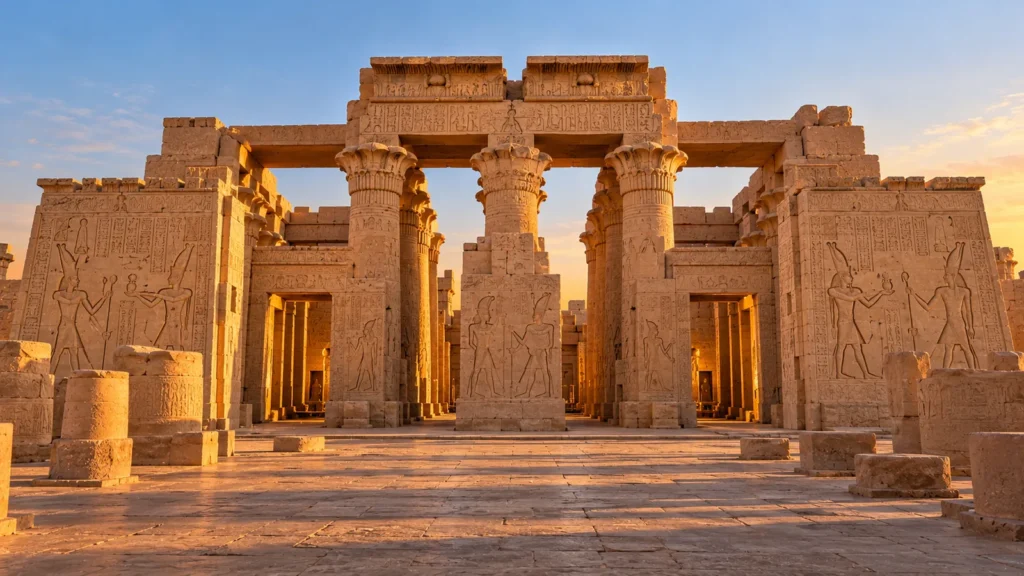
Fascinating Facts About Kom Ombo Temple
Two gods under one roof
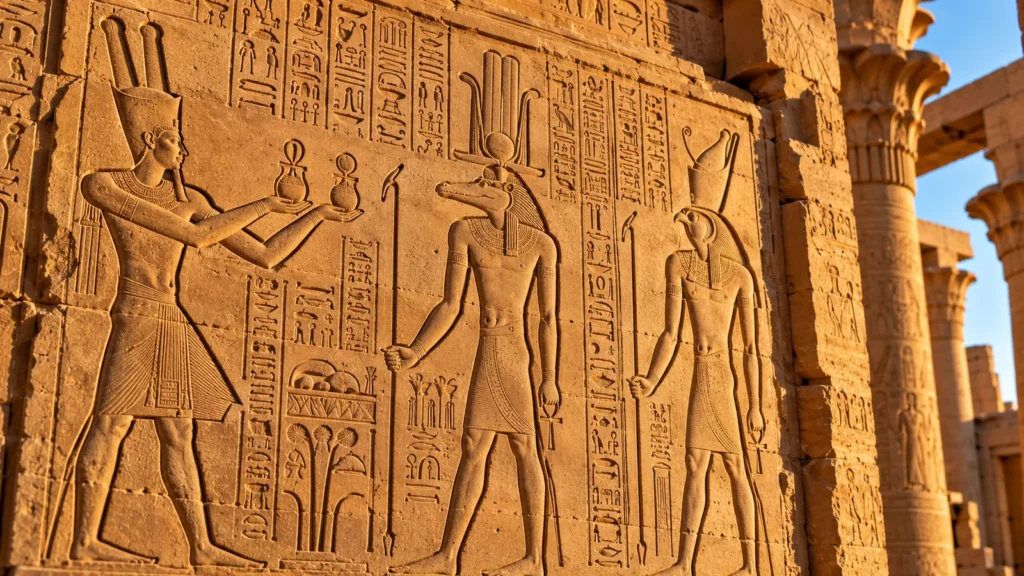
Sobek was the god of the Nile, fertility and protection, and he was shown as a crocodile or a man with a crocodile head. Haroeris, whose name means Horus the Elder, was a falcon-headed god of the sky. Each god had a divine family: Sobek was worshipped with Hathor and the child god Khonsu, and Haroeris with Tasenetnofret (“the Good Sister”) and Panebtawy (“Lord of the Two Lands”).
Built over many centuries
The site is older than the temple you see today. A small gateway of Thutmose III, from the New Kingdom, shows that this place was already sacred more than 3,000 years ago. The main temple was begun under the Ptolemies in the second century BC, and later Ptolemaic kings and Roman emperors added halls, walls and carvings.
Sacred crocodiles
In ancient Egypt, crocodiles were sacred animals in the cult of Sobek, and many were mummified after death. A few of these mummies are displayed at the Crocodile Museum next to the temple.
A famous relief of medical tools
On the rear wall of the temple, a well-known relief shows objects that look like surgical and medical instruments. Egyptologists still discuss exactly what the scene means, but it is one of the most photographed carvings at Kom Ombo.
A calendar and a Nilometer
The walls carry a carved calendar of religious festivals, and the complex also has a Nilometer, a stone well used to measure the level of the Nile. Both show how closely the temple was linked to the river and to the rhythm of the seasons.
A temple the river has damaged
Over the centuries, the Nile has eaten into the riverbank, and earthquakes and the reuse of stone have also taken their toll. This is why the front part of the temple is partly ruined, even though its columns and inner halls survive in good condition.
What You Will See Inside the Temple
- The outer court and altar: the open space where offerings were made.
- The hypostyle halls: columns with carved papyrus and lotus capitals.
- The two sanctuaries: one for Sobek and one for Haroeris, side by side.
- Reliefs of kings and gods: Ptolemaic and Roman rulers making offerings.
- The calendar and the Nilometer: two details that are easy to miss without a guide.
- The relief of medical instruments: on the outer rear wall.
- The riverside view: the temple sits high above the Nile, which makes it a great photo spot, especially in the late afternoon.
A good guide makes the double design easy to understand. That is why we recommend visiting with an Egyptologist. Planning more of Aswan? Read our Aswan travel guide before you go.
How Big Is Kom Ombo Temple and How Long Does a Visit Take?
Kom Ombo is smaller than Karnak or Edfu, which makes it easy and relaxing to visit. You can walk through the whole temple at an easy pace.
- Fast visit: about 45 minutes, enough to see the main halls and sanctuaries.
- Recommended visit: 1 to 1.5 hours with a guide.
- With the Crocodile Museum: add about 20 minutes.
Because the visit is short, Kom Ombo is usually combined with the Temple of Horus at Edfu in one day, or with a stop on a Nile cruise.
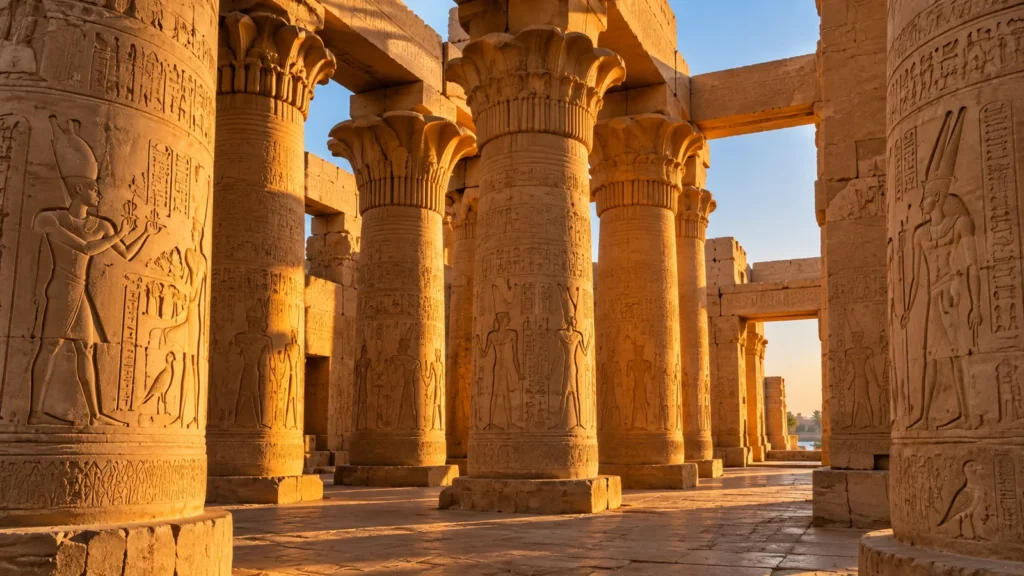
The Best Time to Visit Kom Ombo Temple
Best season: From September to May. The most pleasant months are November to March, while September, October, April and May can still be warm, so an early start helps. In summer (June to August), temperatures in the south are very high.
Best time of day:
- Early morning: cooler weather and fewer visitors.
- Late afternoon: warm golden light on the stone and the river.
- Evening: the temple is lit up at night, and many Nile cruise ships stop here after sunset.
Note: Opening hours and ticket prices change from time to time. When you book with Oceanus Tours, we handle tickets for you.
How to Get to Kom Ombo Temple
- From Aswan: about 40 km north, roughly 1 hour by car.
- From Luxor: about 3.5 to 4 hours by road. The best plan is to stop at Edfu on the way. Edfu and Kom Ombo are about 70 km apart, around 1 to 1.5 hours by car.
- By Nile cruise: Kom Ombo is a regular stop between Luxor and Aswan, and the ship docks close to the temple.
- By air: fly to Aswan (about 1 hour 30 minutes from Cairo), then continue by road.
Transport and Travel Services We Provide
Oceanus Tours arranges your Kom Ombo visit from door to door:
- Private car with driver: an air-conditioned car and a professional driver for couples, families and small groups.
- Coaster and minibus: comfortable air-conditioned transport for larger groups.
- Domestic flights: we book your flights to Aswan and arrange airport transfers.
- Nile cruises: choose from our Nile cruises or a more intimate Dahabiya Nile cruise, such as our 4-night, 5-day Dahabiya cruise. Kom Ombo, the boat stops and your guide are part of the program.
- Egyptologist guide and tickets: a knowledgeable local guide, with entry tickets handled for you.

Ready-Made Kom Ombo Tour
Short on time? We arrange private day trips to Kom Ombo and Edfu from Luxor or Aswan, with an Egyptologist guide and a private air-conditioned car. See our Aswan day tours, or contact us for a tailor-made plan. If you are also visiting Aswan, our Private Aswan Highlights Tour covers the High Dam, Philae Temple and the Unfinished Obelisk.
Quick Tips for Your Visit
- Go early or late in the day for cooler weather and softer light.
- Bring water, a hat and sunscreen, and wear comfortable shoes.
- Take a guide, so the double design and the carvings make sense.
Why Book Your Kom Ombo Tour with Oceanus Tours
There are many ways to see Kom Ombo, but not all of them are equally smooth. Here is what travelers get when they book with us:
- 25+ years of experience: a Luxor-based team that has organized trips across Egypt for more than 25 years, and our newer team members are just as experienced.
- Trusted by travelers: more than 46,000 happy travelers and 100 verified reviews on Tripadvisor.
- Expert Egyptologist guides: knowledgeable local guides who bring every temple and carving to life.
- Private and tailor-made: tours designed around your dates, pace and budget, from a half-day visit to a full travel package.
- Everything in one place: transport, guide, tickets and, if you wish, flights and a Nile cruise.
- Comfortable, safe vehicles: modern, air-conditioned cars, minibuses and Coasters with professional drivers.
- Transparent pricing: you know what is included before you pay, with no hidden extras.
Frequently Asked Questions About Kom Ombo Temple
Is Kom Ombo Temple worth visiting?
Yes. It is one of the few double temples in Egypt, the visit takes only 1 to 1.5 hours, and it sits right on the Nile, so it fits easily into a trip between Luxor and Aswan, especially with a stop at Edfu.
Where is Kom Ombo Temple located?
Kom Ombo Temple is on the east bank of the Nile, about 40 km north of Aswan, in southern Egypt.
Who was Kom Ombo Temple dedicated to?
It was dedicated to two gods: Sobek, the crocodile god, and Haroeris, the falcon-headed Horus the Elder.
Why is Kom Ombo called a double temple?
Because it has two parallel halves, with two entrances, two halls and two sanctuaries, arranged symmetrically along one axis.
When was Kom Ombo Temple built?
Most of it was built in the Ptolemaic period, starting in the second century BC, and the Romans added to it later. A small gateway of Thutmose III shows the site is even older.
How long does it take to visit Kom Ombo Temple?
Most visitors spend 1 to 1.5 hours at the temple.
What is the best time of year to visit?
From September to May, with the most pleasant weather from November to March. Early morning and late afternoon are the best times of day.
Can I visit Kom Ombo and Edfu in one day?
Yes. They are about 70 km apart, and both are easy to combine on a private day trip from Luxor or Aswan.
Can I see Kom Ombo on a Nile cruise?
Yes. It is a regular stop on Nile cruises between Luxor and Aswan.
Do I need a guide?
A guide is not mandatory, but we strongly recommend one. The double design, the calendar and the medical relief are much easier to appreciate with an Egyptologist.
Plan Your Kom Ombo Temple Visit with Confidence
Kom Ombo Temple is one of the most interesting and relaxed stops between Luxor and Aswan: a double temple, a riverside setting and a visit of just 1 to 1.5 hours. Here is what to remember before you go:
- Visit between September and May, and arrive early or in the late afternoon.
- Allow 1 to 1.5 hours for the visit.
- Combine Kom Ombo with Edfu, or include it in a Nile cruise from Luxor to Aswan.
- Book your transport and guide in advance to avoid stress.
Whether you want a private car from your hotel, a Coaster for your group, a flight to Aswan or a complete Nile cruise, Oceanus Tours will take care of every detail, from the first message to your drop-off at the end of the day.
Contact Oceanus Tours today on (+20) 101 806 4111 or at info@oceanusluxor.com, or send us your inquiry to request your free quote. Tell us your dates and group size, and our team will prepare a tailor-made plan for you.
Explore more with Oceanus Tours: Aswan Day Tours | Nile Cruises | Dahabiya Nile Cruise | Travel Packages | Aswan Travel Guide